
Table of Contents
Introduction
Efficient production is essential for businesses to meet customer demand while controlling costs and maintaining product quality. To achieve this, businesses must carefully plan what to produce, how much to produce, when to produce it, and the resources required. Effective production planning helps businesses improve productivity, reduce waste, and ensure that products are delivered on time.
What is Production Planning ?
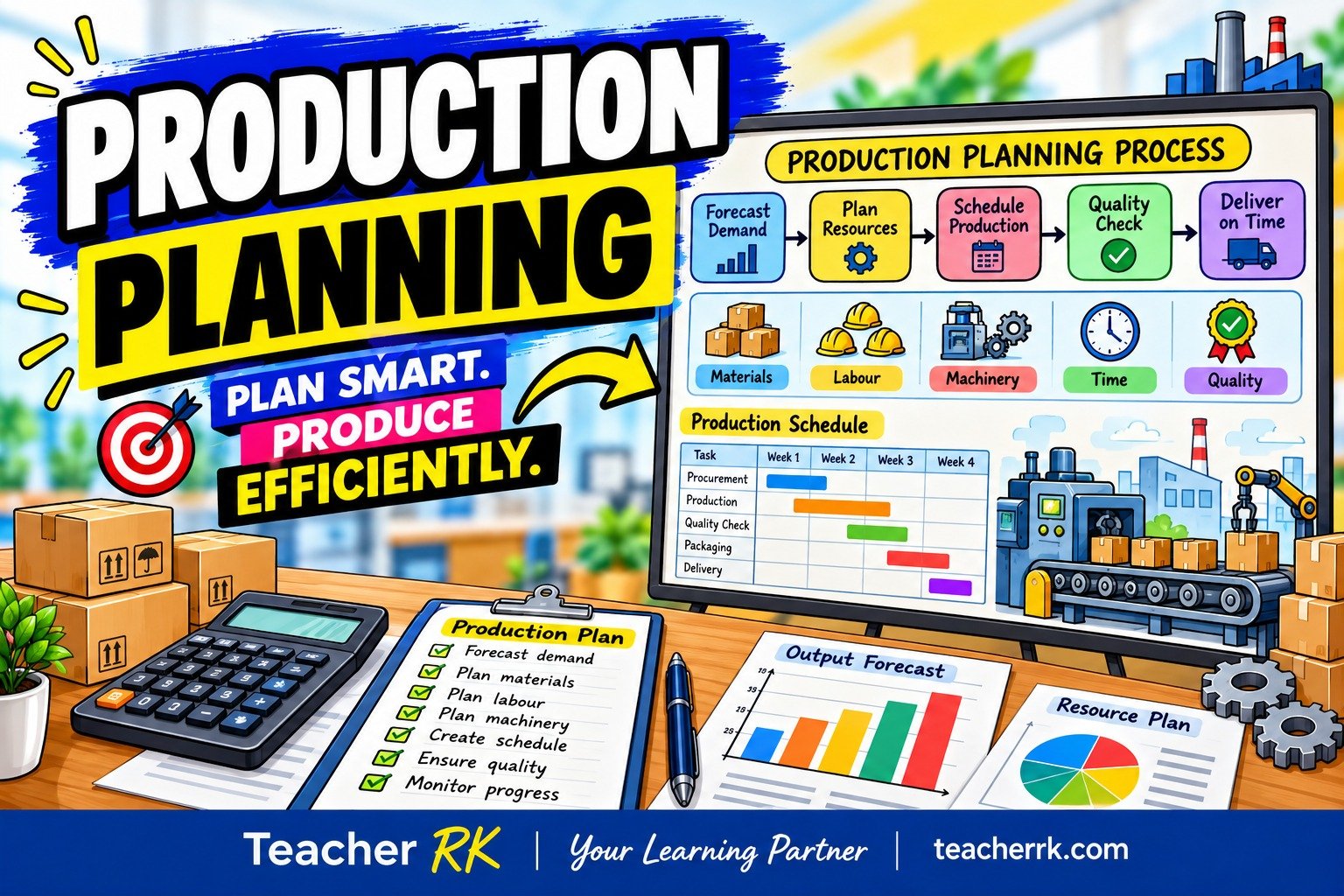
Production planning is the process of deciding what to produce, how much to produce, when to produce it, and how resources such as labour, materials, machinery, and technology will be used to meet customer demand efficiently.
Production planning ensures that the right products are produced in the right quantity, at the right time, and at the lowest possible cost.
What is Supply Chain Process ?
The supply chain process refers to the sequence of activities involved in moving goods, services, information, and finances from the suppliers of raw materials to the final customer. It ensures that products are produced and delivered efficiently while meeting customer requirements. A well-managed supply chain reduces costs, improves efficiency, and enhances customer satisfaction.
Features of an effective Supply Chain
· Involves the flow of materials, information, and finances.
· Links suppliers, manufacturers, distributors, retailers, and customers.
· Requires coordination among all supply chain partners.
· Focuses on delivering products efficiently and on time.
· Aims to minimise costs while maximising customer satisfaction.
Just-in-Time (JIT) and Just-in-Case (JIC)
Inventory management plays a vital role in the efficient operation of a business. Businesses must decide how much inventory to keep to meet customer demand while minimizing costs. Two common inventory management approaches are Just-in-Time (JIT) and Just-in-Case (JIC). Each method has its own advantages and limitations, and the choice depends on factors such as the nature of the business, customer demand, and supply chain reliability.
Just-in-Time (JIT)
Just-in-Time (JIT) is an inventory management system in which materials and components are ordered and received only when they are needed for production or sales. The aim is to minimise inventory levels and reduce storage costs.
| Advantages of JIT | Disadvantages of JIT |
| 1. Lower inventory holding costs as businesses store minimal stock.· 2. Reduces waste and improves efficiency by receiving materials only when required. | 1. Risk of production delays if suppliers fail to deliver on time.· 2. Highly dependent on reliable suppliers and efficient transportation systems. |
Just-in-Case (JIC)
Just-in-Case (JIC) is an inventory management system in which businesses maintain extra inventory to protect against unexpected increases in demand or supply chain disruptions.
| Advantages of JIC | Disadvantages of JIC |
| 1. Reduces the risk of stock shortages, ensuring products are available when needed.· 2. Protects the business from supply chain disruptions and unexpected delays. | 1. Higher inventory holding and storage costs due to maintaining large stock levels.· 2. Greater risk of inventory becoming obsolete or damaged, particularly for perishable or rapidly changing products. |
JIT focuses on minimising inventory and reducing costs, making it suitable for businesses with reliable suppliers and predictable demand. JIC focuses on maintaining safety stock to ensure product availability, making it more suitable where demand is uncertain or supply disruptions are common.
Stock Control
Inventory is one of the most valuable assets of many businesses. Holding too much inventory increases storage costs and the risk of damage or obsolescence, while holding too little inventory may result in stock shortages and lost sales. Therefore, businesses need an effective stock control system to ensure that the right amount of inventory is available at the right time.
What is Stock Control ?
Stock Control Meaning (inventory control) is the process of monitoring, managing, and maintaining inventory at appropriate levels to ensure that production and customer demand are met while minimizing inventory-related costs. Effective stock control helps businesses avoid both excess inventory and stock shortages.
Features of Stock Control
· Ensures adequate inventory is available when needed.
· Monitors inventory levels regularly.
· Reduces storage and inventory holding costs.
· Prevents stock shortages and overstocking.
· Supports efficient production and customer service.
Types of Stock
Businesses usually hold different types of inventory to support their operations.
· Raw Materials : Materials and components purchased from suppliers that are used in the production process.
· Work-in-Progress (WIP): Products that are currently being manufactured but are not yet complete ( semi-finished)
· Finished Goods: Completed products that are ready for sale or distribution to customers.
Stock Control Chart
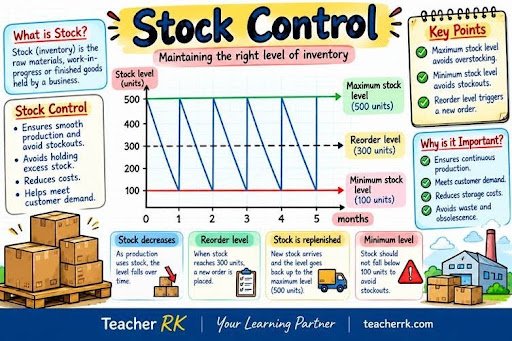
A stock control chart is a graphical tool used to monitor inventory levels over time. It helps businesses determine when to place new orders and how much inventory should be maintained to avoid stock shortages or excessive inventory. A typical stock contro chart includes the following components:
Components of a Stock Control Chart
- Maximum Stock Level: The maximum stock level is the highest quantity of inventory a business should hold. Holding inventory above this level increases storage costs and the risk of damage, theft, or obsolescence.
- Minimum Stock Level (Buffer Stock): The minimum stock level, also called buffer stock or safety stock, is the lowest quantity of inventory that should always be available. It acts as a reserve to protect the business against unexpected increases in demand or delays in deliveries from suppliers.
- Reorder Level: The reorder level is the inventory level at which a new order should be placed to replenish stock before it reaches the minimum stock level. Ordering at the correct time helps prevent stock shortages and production interruptions.
- Reorder Quantity (Economic Order Quantity): The reorder quantity is the amount of inventory ordered each time the stock reaches the reorder level. The quantity is chosen to balance ordering costs and inventory holding costs while ensuring adequate stock availability.
- Lead Time: Lead time is the time taken between placing an order with a supplier and receiving the inventory. Businesses must consider lead time when determining the reorder level to ensure that new stock arrives before existing inventory runs out.
| Quick summary: Maximum stock = The highest inventory level.· Reorder level = The point at which a new order is placed.· Lead time = The waiting period before the order arrives.· Minimum (buffer) stock = The lowest safe inventory level.· Reorder quantity = The amount ordered to replenish stock from the minimum level back to the maximum level. |
Example
A supermarket keeps 500 cartons of milk as its maximum stock level.
- Maximum stock: 500 cartons
- Reorder level: 200 cartons
- Minimum (Buffer) stock: 100 cartons
- Reorder quantity: 300 cartons
- Lead time: 3 days
When inventory falls to 200 cartons, the supermarket places an order for 400 cartons. During the 3-day lead time, inventory continues to decrease but should not fall below the buffer stock. Once the delivery arrives, the stock level returns close to the maximum level.
Thus, stock control enables businesses to maintain the right balance between inventory availability and inventory costs. By monitoring stock levels and using tools such as maximum stock level, minimum (buffer) stock, reorder level, reorder quantity, and lead time, businesses can improve efficiency, reduce costs, and meet customer demand effectively.
Other concepts
Capacity Utilisation: Capacity utilisation measures the percentage of a business’s maximum production capacity that is actually being used during a given period.
| Formula: Capacity Utilisation (%) = (Actual Output ÷ Maximum Output) × 100 |
Defect Rate: Defect rate is the percentage or proportion of products that fail to meet the required quality standards and are considered defective.
| Formula: Defect Rate (%) = (Number of Defective Units ÷ Total Units Produced) × 100 |
Productivity: Productivity measures how efficiently a business converts inputs (such as labour, materials, or machinery) into outputs (goods or services).
| Formula: Productivity = Total Output ÷ Total Input |
Cost to Buy (CTB)
Cost to Buy (CTB) is the total cost of purchasing a product or component from an external supplier instead of producing it internally. It includes the purchase price, transportation, import duties, and other procurement costs.
| Formula: CTB = Purchase Price + Transportation Cost + Import Duties/Taxes + Other Procurement Costs |
Cost to Make (CTM)
Cost to Make (CTM) is the total cost of manufacturing a product within the business. It includes the costs of raw materials, labour, overheads, machinery, and other production-related expenses.
| CTM = Total Fixed Costs + Total Variable Costs |
| Decision Rule: Businesses often compare the two costs: If CTM < CTB → Produce (Make) the product internally. If CTB < CTM → Purchase (Buy) the product from an external supplier. This Make-or-Buy Decision helps businesses choose the most cost-effective option while also considering quality, capacity, lead time, and strategic factors. |
Quick Recap
1. Define production planning: Production planning is the process of deciding what, how much, when, and how to produce to meet customer demand efficiently.
2. The supply chain process involves the movement of materials, information, and products from suppliers to the final customer.
3. Just-in-Time (JIT) aims to minimise inventory by receiving materials only when they are needed, reducing storage costs but increasing the risk of stock shortages.
4. Just-in-Case (JIC) maintains extra inventory to protect against unexpected demand or supply disruptions, but results in higher holding costs.
5. Stock control is the process of managing inventory to ensure the right quantity of stock is available while minimising inventory-related costs.
6. Businesses generally hold three types of stock: raw materials, work-in-progress (WIP), and finished goods.
7. A stock control chart helps businesses monitor inventory levels and identify when to reorder stock.
8. The main components of a stock control system are maximum stock level, minimum (buffer) stock level, reorder level, reorder quantity, and lead time.
9. Capacity utilisation measures how effectively a business uses its production capacity, while productivity measures how efficiently inputs are converted into outputs.
10. Cost to Buy (CTB) and Cost to Make (CTM) help businesses make make-or-buy decisions by comparing the cost of purchasing a product externally with the cost of producing it internally.








One Comment