Table of Contents
Introduction
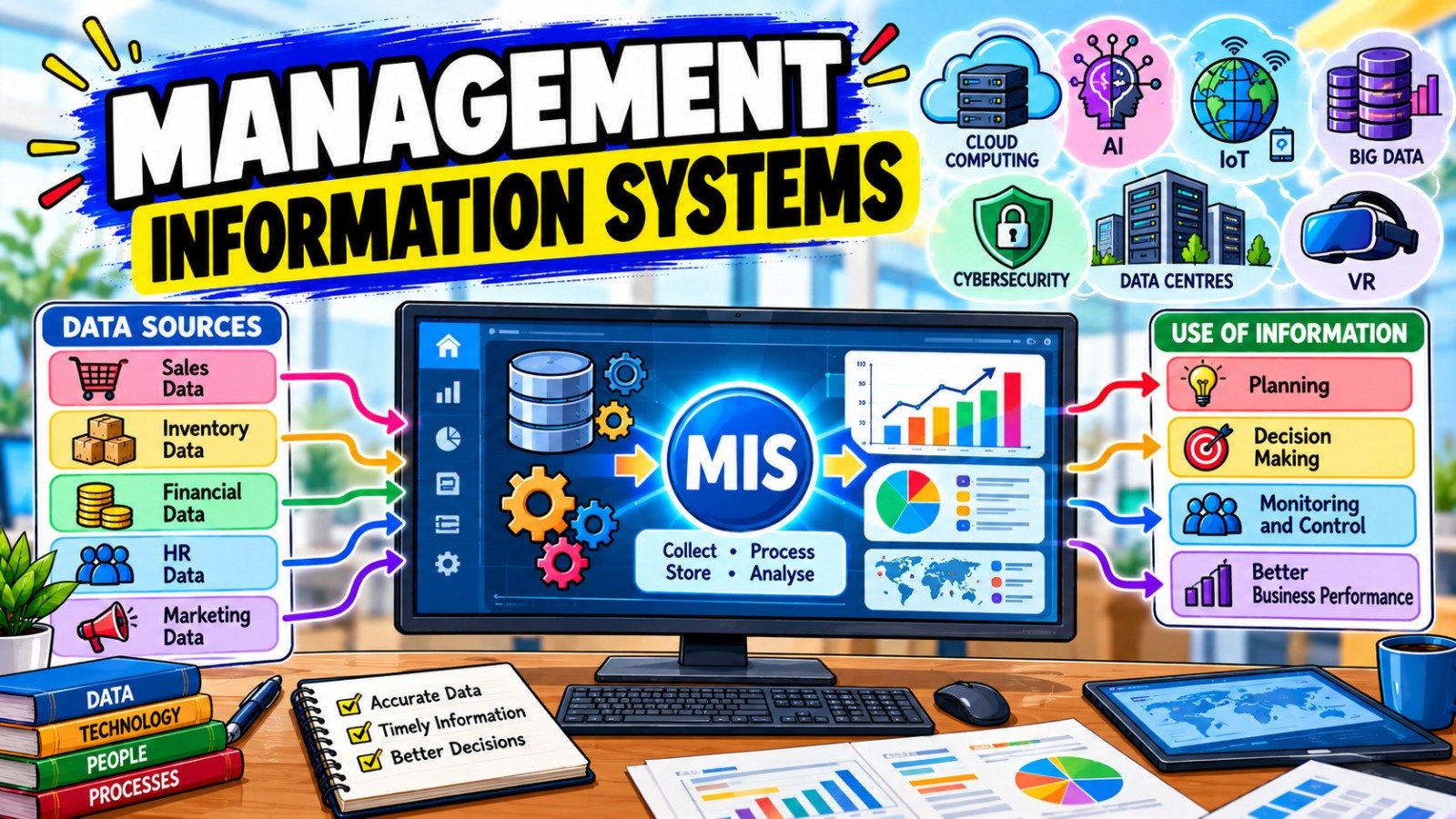
In today’s digital business environment, managers must make quick and informed decisions to remain competitive. Businesses generate large amounts of data every day through sales, production, finance, marketing, and human resource activities. Management Information Systems (MIS) help collect, process, store, and analyse this data, providing managers with accurate and timely information to support planning, decision-making, and business operations.
Meaning of Management Information System (MIS)
A Management Information System (MIS) is a computer-based system that collects, processes, stores, and provides information to managers to support planning, decision-making, coordination, and control within an organization. MIS transforms raw business data into meaningful information that helps managers make effective decisions.
Features of a Management Information System (MIS)
· Collects and stores business data from different functional areas.
· Processes data into meaningful and useful information.
· Provides timely and accurate information for decision-making.
· Supports planning, monitoring, and control of business activities.
· Integrates information across different departments of the business.
Example: A supermarket uses an MIS to monitor daily sales, inventory levels, customer purchases, and supplier deliveries. Managers use this information to reorder stock, forecast demand, and make pricing decisions.
Some of key terms
Data Analytics: Data analytics is the process of collecting, analysing, and interpreting data to identify patterns, trends, and insights that support better business decision-making.
Database: A database is an organised collection of related data that is stored electronically and can be easily accessed, managed, and updated.
Cybersecurity and Cybercrime: Cybersecurity refers to the measures taken to protect computer systems, networks, and data from unauthorized access and cyber threats. Cybercrime involves illegal activities such as hacking, identity theft, data breaches, and online fraud.
Data Centres: Data centres are secure facilities that house computer systems, servers, and storage devices used to process, store, and manage large amounts of business data.
Cloud Computing: Cloud computing is the delivery of computing services, such as data storage, software, and processing power, over the internet instead of using local computers or servers.
Virtual Reality (VR): Virtual reality (VR) is a technology that creates a computer-generated, immersive three-dimensional environment that users can interact with using special devices such as VR headsets.
The Internet of Things (IoT): The Internet of Things (IoT) refers to a network of physical devices connected to the internet that can collect, share, and exchange data automatically.
Artificial Intelligence (AI): Artificial intelligence (AI) is the ability of computer systems to perform tasks that normally require human intelligence, such as learning, problem-solving, decision-making, and language recognition.
Big Data: Big data refers to extremely large and complex datasets that can be analysed to identify patterns, trends, and relationships to support business decision-making.
Customer Loyalty Programmes: Customer loyalty programmes are reward schemes designed to encourage repeat purchases by offering customers incentives such as points, discounts, cashback, or exclusive benefits.
Digital Taylorism: Digital Taylorism is the use of digital technologies, data, and performance monitoring systems to measure, standardise, and improve employee productivity and work efficiency.
Data Mining: Data mining is the process of analysing large datasets to discover hidden patterns, relationships, and trends that help businesses make better decisions and predict future customer behaviour.
A quick recap
1) Management Information System (MIS): A computer-based system that collects, processes, stores and provides information to support management decisions.
2) Purpose of MIS: Helps managers with planning, decision-making, coordination, monitoring and control.
3) Features of MIS: Collects business data, processes it into useful information, provides timely reports and integrates information across departments.
4) Data Analytics: Analysing and interpreting data to identify patterns, trends and insights for better decisions.
5) Database: An organised collection of related data that can be accessed, managed and updated electronically.
6) Cybersecurity and Cybercrime: Cybersecurity protects systems and data, while cybercrime involves illegal activities such as hacking, identity theft and online fraud.
7) Data Centres: Secure facilities containing servers, computer systems and storage devices used to manage business data.
8) Cloud Computing: Delivering computing services, such as software and data storage, over the internet.
9) Virtual Reality (VR): Technology that creates immersive, computer-generated 3D environments for users to interact with.
10) Internet of Things (IoT): A network of internet-connected physical devices that collect and exchange data automatically.
11) Artificial Intelligence (AI): Technology that enables computers to perform tasks such as learning, problem-solving and decision-making.
12) Big Data: Extremely large and complex datasets that businesses analyse to identify trends, patterns and relationships.
13) Customer Loyalty Programmes: Schemes offering rewards, points, discounts or cashback to encourage repeat purchases.
14) Digital Taylorism: Using digital technology and performance monitoring to measure, standardise and improve employee productivity.
15) Data Mining: Analysing large datasets to discover hidden patterns and relationships and predict customer behaviour.
16) Business application of MIS: A supermarket can use sales, inventory and customer data to forecast demand, reorder stock and make pricing decisions.