
Table of Contents
Introduction
To remain competitive in today’s dynamic business environment, businesses must continuously improve their products, services, and production processes. Customer needs, technology, and market conditions change over time, making innovation essential for long-term success. Research and development (R&D) enables businesses to create new products, improve existing ones, and develop more efficient ways of operating.
Meaning of research and development
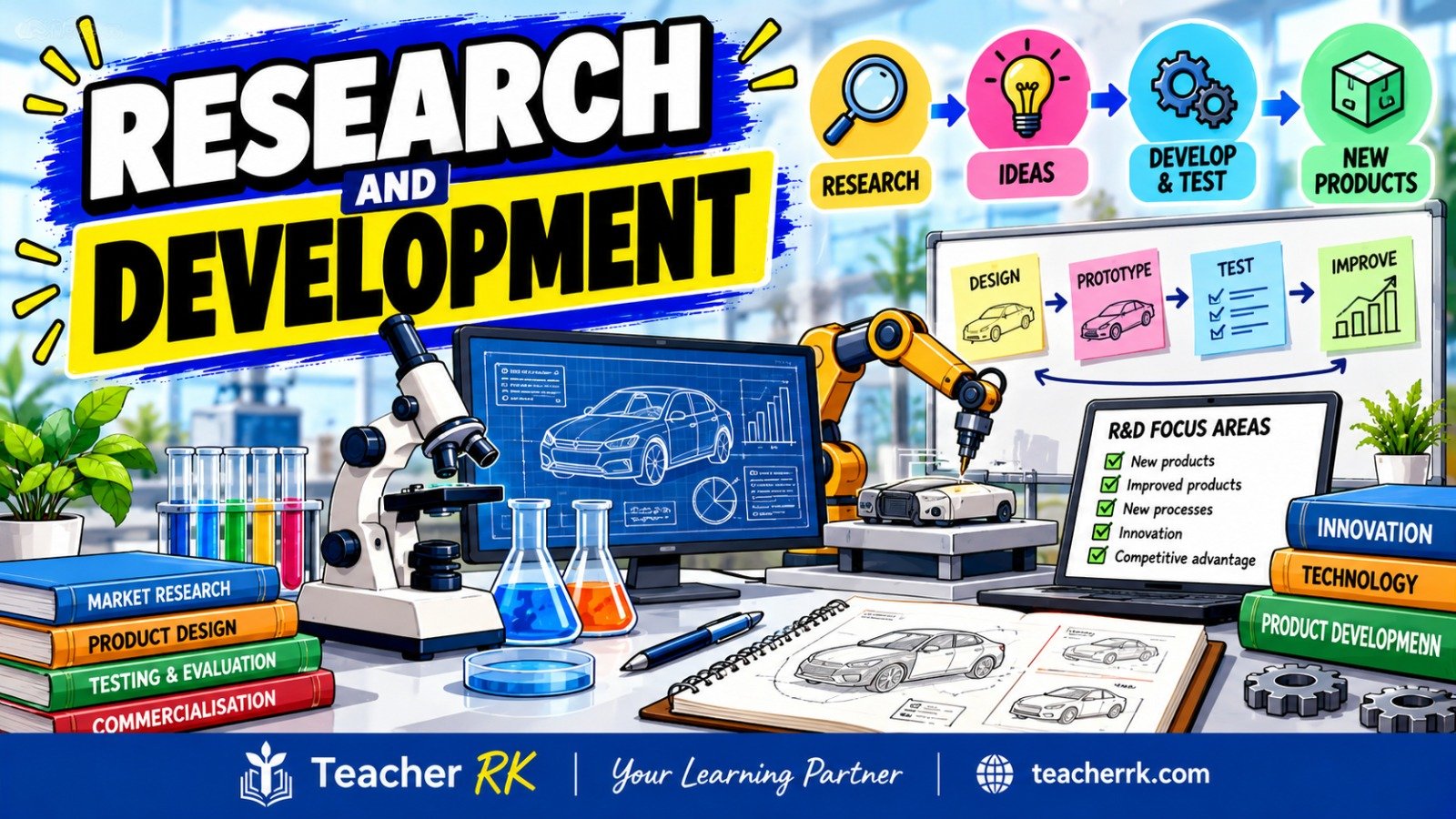
Research and development (R&D) is the systematic process of conducting research and applying new knowledge to develop new products, improve existing products, services, or processes, and encourage innovation within a business. The primary objective of R&D is to enhance competitiveness, satisfy changing customer needs, and support long-term business growth.
Features of Research and Development
· Focuses on innovation and continuous improvement.
· Involves developing new products, services, or production processes.
· Requires investment in time, money, and skilled employees.
· Helps businesses respond to changing customer needs and market trends.
· Supports long-term growth and competitiveness.
Importance of research and development for a business
· Encourages innovation: R&D enables businesses to develop new products, services, and technologies, helping them remain competitive in the marketplace.
· Improves product quality: Research helps businesses identify ways to improve the quality, performance, reliability, and features of existing products.
· Increases competitive advantage: Businesses that invest in R&D can differentiate their products from competitors, making it more difficult for rivals to imitate them.
· Improves production efficiency: R&D can lead to improved production methods, reducing costs, increasing productivity, and minimizing waste.
· Meets changing customer needs: Customer preferences change over time. R&D helps businesses develop products and services that better satisfy customer expectations.
· Supports long-term growth: Continuous investment in research and innovation helps businesses expand into new markets, develop new revenue streams, and achieve sustainable growth.
· Increases profitability: Successful innovations often lead to higher sales, greater customer loyalty, and increased profits over the long term.
A smartphone manufacturer invests in R&D to develop a longer-lasting battery and advanced artificial intelligence features. The improved product attracts more customers, strengthens the company’s competitive position, and increases sales.
Research and development (R&D) is a strategic investment that enables businesses to innovate, improve products and processes, increase efficiency, satisfy customer needs, and achieve long-term competitive advantage and growth.
Intellectual property protection
Businesses invest significant time, money, and effort in developing new products, designs, brands, and creative works. Without legal protection, competitors could copy these ideas and benefit from someone else’s innovation. Intellectual property (IP) protection helps businesses safeguard their creations, maintain a competitive advantage, and encourage innovation.
Meaning of intellectual property protection
Intellectual property (IP) protection or rights refers to the legal rights granted to individuals or businesses to protect their original ideas, inventions, creative works, and brand identities from being copied or used without permission. The three common forms of intellectual property protection are copyrights, patents, and trademarks.
Copyright
A copyright is a legal right that protects original creative works, such as books, music, films, artwork, software, photographs, and websites. It gives the creator the exclusive right to reproduce, distribute, or use the work.
Examples: A novel written by an author, a movie produced by a film studio, and computer software developed by a technology company
Patent
A patent is a legal right granted to an inventor that gives exclusive rights to make, use, or sell an invention for a specified period of time. It protects new products, processes, or technological innovations.
Examples: A new pharmaceutical drug, an innovative engine design, and a new manufacturing process
Trademark
A trademark is a legally registered name, logo, symbol, slogan, or design that identifies and distinguishes the goods or services of one business from those of others.
Examples: The Nike “Swoosh” logo , the Apple logo , and the Coca-Cola brand name
Differences Between Copyright, Patent, and Trademark
| Copyright | Patent | Trademark |
| Protects original creative works.· Applies to books, music, films, software, and artwork· Prevents unauthorized copying or distribution | Protects inventions and innovations.· Applies to new products, processes, and technologies.· Prevents others from making or using the invention without permission | Protects brand names, logos, symbols, and slogans· Applies to a business’s brand identity.· Prevents competitors from using similar brand identifiers that may confuse customers |
Innovation
In today’s highly competitive business environment, innovation is essential for long-term success. Businesses must continuously develop new products, improve existing products, adopt new technologies, and introduce better ways of operating to meet changing customer needs. Innovation enables businesses to gain a competitive advantage, improve efficiency, and achieve sustainable growth.
Meaning of innovation
Innovation is the process of introducing new or significantly improved products, services, processes, or business models that create value for customers and the business.
Innovation does not always mean inventing something completely new; it can also involve improving existing products or processes.
Features of innovation
· Involves creating or improving products, services, or processes.
· Adds value for customers and the business.
· Helps businesses remain competitive.
· Encourages continuous improvement.
· Supports long-term growth and profitability.
Types of innovation
Businesses generally adopt two types of innovation: incremental innovation and disruptive innovation.
Incremental Innovation
Incremental innovation involves making small, continuous improvements to existing products, services, or processes. These improvements enhance quality, performance, or customer satisfaction without fundamentally changing the product or the market.
Examples
- Apple introducing improved cameras and battery life in newer iPhone models.
- Car manufacturers adding advanced safety features to existing vehicle models.
- A restaurant introducing healthier menu options.
Disruptive innovation
Disruptive innovation introduces a completely new product, service, technology, or business model that significantly changes or creates a market. It often replaces existing products or transforms the way businesses operate.
Examples
· Netflix replacing traditional DVD rental businesses with online streaming.
· Uber transforming the taxi industry through ride-sharing technology.
· Digital photography replacing traditional film cameras.
Thus, innovation enables businesses to remain competitive and achieve long-term success. Incremental innovation focuses on continuous improvements to existing products or processes, while disruptive innovation introduces breakthrough changes that can transform industries and create new markets.
Quick Recap
1. Research and Development (R&D) involves conducting research and applying new knowledge to develop or improve products, services, and production processes.
2. Investing in R&D helps businesses encourage innovation, improve product quality, increase efficiency, and achieve long-term growth.
3. Intellectual property (IP) protection gives businesses legal rights to protect their ideas, inventions, creative works, and brand identity from unauthorized use.
4. Copyright protects original creative works such as books, music, films, artwork, and software, while patents protect inventions and trademarks protect brand names, logos, and symbols.
5. Innovation is the process of introducing new or significantly improved products, services, processes, or business models that create value for customers and the business.
6. Incremental innovation involves making small, continuous improvements to existing products, services, or processes to enhance their performance or quality.
7. Disruptive innovation introduces breakthrough products, technologies, or business models that transform existing markets or create entirely new ones.
8. Businesses that invest in R&D, innovation, and intellectual property protection are better positioned to gain a competitive advantage, satisfy changing customer needs, and achieve sustainable success.