
Table of Contents
2.1 What is HRM (Human Resource Management)?
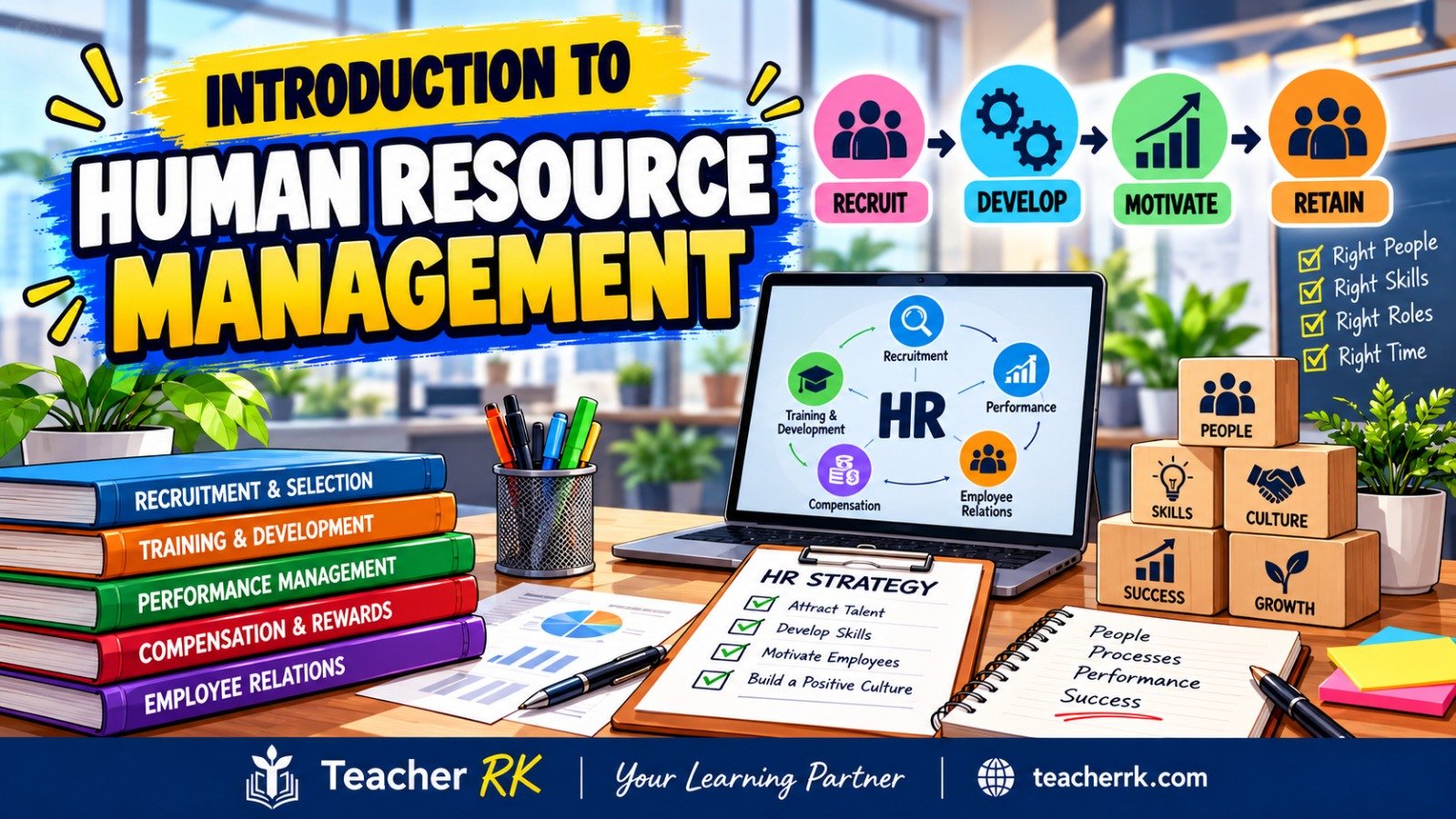
Human Resource Management (HRM) is the process of recruiting, selecting, training, motivating, and managing employees to help an organisation achieve its objectives. Employees are one of the most valuable resources of any business because their skills, knowledge, creativity, and commitment contribute to its success.
HRM involves ensuring that the right people are employed in the right roles, provided with appropriate training, and motivated to perform effectively. It also includes managing employee relations, evaluating performance, and promoting employee well-being.
In simple words: Human Resources Management is about managing people effectively so that both employees and the organisation can succeed.
Example: A company such as Google invests in recruiting talented employees, providing professional development opportunities, and creating a supportive work environment to encourage innovation and improve performance.
The ultimate aim of HRM is to align employee performance with organisational objectives while meeting the needs of the workforce.
2.2 Definition of Human Resource Management
Human Resources Management (HRM) is the strategic approach to the effective management of people in an organization, aiming to optimize employee performance in service of the organization’s strategic objectives.
HRM involves recruiting, training, developing, and retaining employees, as well as managing employee relations, ensuring compliance with labor laws, and fostering a positive organizational culture. Its goal is to maximize the potential of the workforce, ensuring that the organization has the right people with the right skills in the right roles at the right time.
2.3 Objectives of HRM
· Workforce planning
· Recruitment and selection
· Training and development
· Performance management
· Compensation and benefits
· Employee relations
· Compliance with labor laws
· Organizational development
· Health and safety
· Succession planning
· Employee engagement and retention
2.4 Functions of HRM
Human resource management review plays a crucial role in any organization by managing its most valuable asset: its people. Here are the key roles of HRM:
· Recruitment and selection – Attracting, interviewing, and hiring suitable employees for job vacancies.
· Training and development – Providing training and learning opportunities to improve employees’ skills and knowledge.
· Performance management – Monitoring employee performance, setting targets, and providing feedback for improvement.
· Compensation and benefits – Managing salaries, bonuses, incentives, and employee benefits to motivate and retain staff.
· Employee relations – Resolving workplace conflicts, handling grievances, and maintaining positive relationships between employees and management.
· Health, safety, and legal compliance – Ensuring a safe workplace and complying with labour laws and employment regulations.
In summary, HRM is essential for recruiting the right talent, enhancing employee performance, ensuring legal compliance, and contributing to the overall success and growth of the organization.
Importance of HRM
Every business runs on people, and HRM (human resource management) is what keeps those people motivated, skilled and working in the right direction. A company can have the best product and plenty of money, but without the right team it will struggle. This is where HR management makes the real difference.
Here is why HRM matters:
- It brings in the right people. Good recruitment and selection mean the business hires people who fit the role and the culture, not just anyone who is available.
- It builds skills. Through regular training and development, employees stay up to date and ready for bigger responsibilities.
- It keeps employees happy. Fair pay, a healthy workplace and recognition make people want to stay, which lowers staff turnover.
- It improves productivity. When employees know what is expected and feel valued, they naturally perform better.
- It helps manage change. As we saw in the previous section, change creates fear and resistance. A strong HR team communicates clearly, involves employees and helps everyone adapt smoothly.
- It protects the business legally. HRM makes sure the organisation follows labour laws, safety rules and fair employment practices.
In short, HRM turns a group of individuals into a team that achieves business goals.
HRM Process
The HRM process is the step-by-step journey of an employee inside an organisation, from the day the business realises it needs someone to the day that person leaves. Most organisations follow these stages:
- Human resource planning: Estimating how many people the business needs and what skills they should have.
- Recruitment: Attracting suitable candidates through job portals, campus hiring, referrals and advertisements.
- Selection: Choosing the best candidate through tests, interviews and background checks.
- Induction and orientation: Welcoming the new employee and explaining the company’s rules, culture and expectations.
- Training and development: Improving the employee’s knowledge and skills for the current job and future roles.
- Performance appraisal: Evaluating how well the employee is doing and giving honest feedback.
- Compensation and benefits: Providing salary, bonuses, insurance and other rewards in a fair way.
- Employee relations and retention: Handling grievances, building trust and keeping good employees for the long term.
- Separation: Managing resignation, retirement or termination in a professional and respectful way.
This process is continuous. HR managers keep reviewing and improving each stage as the business grows and changes.
Scope of HRM
The scope of HRM is very wide because it covers everything related to people at work. It is usually divided into three areas.
1. Personnel aspect: This deals with the employees directly: manpower planning, recruitment, selection, placement, training, transfers, promotions, performance appraisal and compensation.
2. Welfare aspect: This focuses on the well-being of employees: working conditions, health and safety, canteen, housing, medical facilities, education and recreation.
3. Industrial relations aspect: This covers the relationship between management, employees and trade unions: collective bargaining, dispute resolution, grievance handling and employee participation in decisions.
Today the scope has grown even further. Modern HR management also includes HR analytics, employee engagement, diversity and inclusion, remote work policies and digital HR tools.
HRM vs Personnel Management
Many students think HRM and personnel management are the same thing. They are related, but their approach is quite different. Personnel management is the older, traditional method, while HRM is the modern and more strategic one.
| Basis | Personnel Management | HRM (Human Resource Management) |
|---|---|---|
| Approach | Treats employees as a cost | Treats employees as a valuable asset |
| Focus | Day-to-day administration | Long-term strategy and growth |
| Role | Routine and clerical | Strategic and proactive |
| Employee relations | Mostly with unions, often formal | Direct communication with employees |
| Training | Seen as an expense | Seen as an investment |
| Decision making | Centralised, by the personnel department | Shared with line managers |
| Motivation | Mainly money | Money plus recognition, growth and job satisfaction |
| Goal | Follow rules and procedures | Achieve organisational goals and employee growth |
2.5 Meaning of human resource planning (HRP)
Human resource planning (HRP) is a strategic process that involves forecasting and managing an organization’s current and future human resource needs. The goal of HRP is to ensure that the organization has the right number of employees, with the right skills, in the right positions, at the right time. Here are the key components of HRP:
· Forecasting demand
· Assessing current workforce
· Identifying gaps
· Developing HR strategies
· Implementing HR plans
· Monitoring and evaluating
· Succession planning
· Retention strategies
· Workforce flexibility
2.6 Internal and external factors that influence HRP
| Internal Factors | External factors |
| Organizational strategy Current workforce skills Employee turnover Company culture Budget constraints Technological advancements Internal policies | Economic conditions Labor market trends Regulatory changes Technological changes Competitor actions Demographic changes Globalization |
2.7 Other key concepts:
Gig Economy
The gig economy is a labour market in which people work on short-term contracts, freelance projects, or temporary jobs instead of having permanent employment. Examples include Uber drivers, food delivery workers, and freelance designers.
Flexi-time
Flexi-time is a working arrangement that allows employees to choose their starting and finishing times within limits set by the employer, provided they complete their required working hours.
Home Working
Home working is a work arrangement in which employees perform their job duties primarily from their own homes rather than at the employer’s workplace.
Teleworking
Teleworking is a work arrangement in which employees use information and communication technology, such as computers and the internet, to work remotely from locations outside the office, including home or other remote locations.
| Key Difference: Home Working = Working specifically from home.· Teleworking = Working remotely using technology, from home or any other location.· Flexi-time = Flexible working hours.· Gig Economy = Short-term, freelance, or contract-based work. |
2.8 Resistance to change
Resistance to change occurs when employees are unwilling or reluctant to accept new ways of working within an organisation. It may arise due to fear of job losses, uncertainty, lack of skills, or concerns about increased workloads. This resistance can delay the implementation of new strategies and affect business performance. The key reasons are:
· Fear of the unknown: Employees may be uncertain about what the change will bring and how it will affect them.
· Loss of job security: Workers may worry that changes, especially involving technology or restructuring, could lead to job losses.
· Lack of understanding: Resistance can occur when employees do not fully understand the purpose or benefits of the change.
· Loss of control: People may feel that change reduces their influence, authority, or ability to make decisions.
· Habit and comfort with existing practices: Employees often prefer familiar routines and may be reluctant to adopt new ways of working.
· Poor communication: Inadequate information about the change can create confusion, rumors, and resistance.
· Increased workload: Employees may perceive change as creating additional responsibilities, training requirements, or stress.
· Lack of trust in management: If employees do not trust the leaders implementing the change, they are more likely to resist it.
2.9 Methods to manage change
Managing change involves using strategies to help employees adapt to new systems, processes, or organisational structures. Effective change management reduces resistance, minimises disruption, and encourages employee cooperation, enabling the business to achieve its objectives smoothly. A business may use the following methods to management the change.
1. Communicate the reasons for change clearly.
2. Involve employees in the change process.
3. Provide training and support.
4. Address employee concerns and fears.
5. Offer incentives and rewards for cooperation.
6. Implement change gradually (phased implementation).
7. Monitor progress and provide regular feedback.
8. Implicit/explicit coercion
Quick Recap
1. Human Resource Management (HRM) is the process of recruiting, training, motivating, and managing employees to achieve organisational objectives.
2. The meaning of HRM: HRM is a strategic approach to managing people effectively by ensuring that employees’ skills and performance support business goals.
3. Key functions of HRM include workforce planning, recruitment and selection, training and development, performance management, compensation, employee relations, health and safety, and employee retention.
4. The role of HRM is to attract suitable employees, improve performance, maintain positive employee relations, ensure legal compliance, and contribute to business growth.
5. Human Resource Planning (HRP) involves forecasting and managing future workforce requirements to ensure that the right number of employees with the right skills are available at the right time.
6. The HRP process includes forecasting workforce demand, assessing existing employees, identifying skill gaps, developing HR strategies, implementing plans, and monitoring outcomes.
7. Internal factors influencing HRP include organisational strategy, workforce skills, employee turnover, company culture, budget constraints, technology, and internal policies.
8. External factors influencing HRP include economic conditions, labour market trends, regulatory changes, technological developments, competitor actions, demographic changes, and globalisation.
9. The gig economy refers to a labour market characterised by short-term contracts, freelance projects, and temporary jobs rather than traditional permanent employment.
10. Flexible working arrangements include flexi-time, home working, and teleworking. Flexi-time allows flexibility in working hours, home working involves working from home, and teleworking involves working remotely using information and communication technology.
11. Resistance to change occurs when employees are reluctant to accept new systems, processes, or organisational structures. Common reasons include fear of the unknown, job insecurity, poor communication, increased workload, loss of control, and lack of trust in management.
12. Effective communication helps manage change by explaining its purpose, reducing uncertainty, addressing employee concerns, and building trust.
13. Employee participation, training, and support can reduce resistance by involving employees in decision-making and helping them develop the skills needed to adapt to change.
14. Other methods of managing change include incentives and rewards, phased implementation, regular feedback, and monitoring progress. These methods help minimise disruption and encourage cooperation.
15. Coercion involves using pressure or threats to enforce change (explicit coercion) or applying pressure less directly (implicit coercion). Although it may achieve rapid compliance, it can damage employee morale and trust.
FAQs on HRM
1. What is human resource management?
Human resource management is the practice of recruiting, training, developing and retaining employees while making sure they work effectively towards the goals of the organisation.
2. What does HRM stand for?
HRM stands for Human Resource Management.
3. What is the difference between HRM and HR management?
There is no real difference. “HR management” is just a shorter, everyday way of saying human resource management.
4. What are the main functions of HRM?
The main functions are human resource planning, recruitment, selection, training and development, performance appraisal, compensation and benefits, and employee relations.
5. Why is HRM important for a business?
It helps a business hire the right people, improve productivity, reduce employee turnover and handle organisational change smoothly.