Table of Contents
Introduction
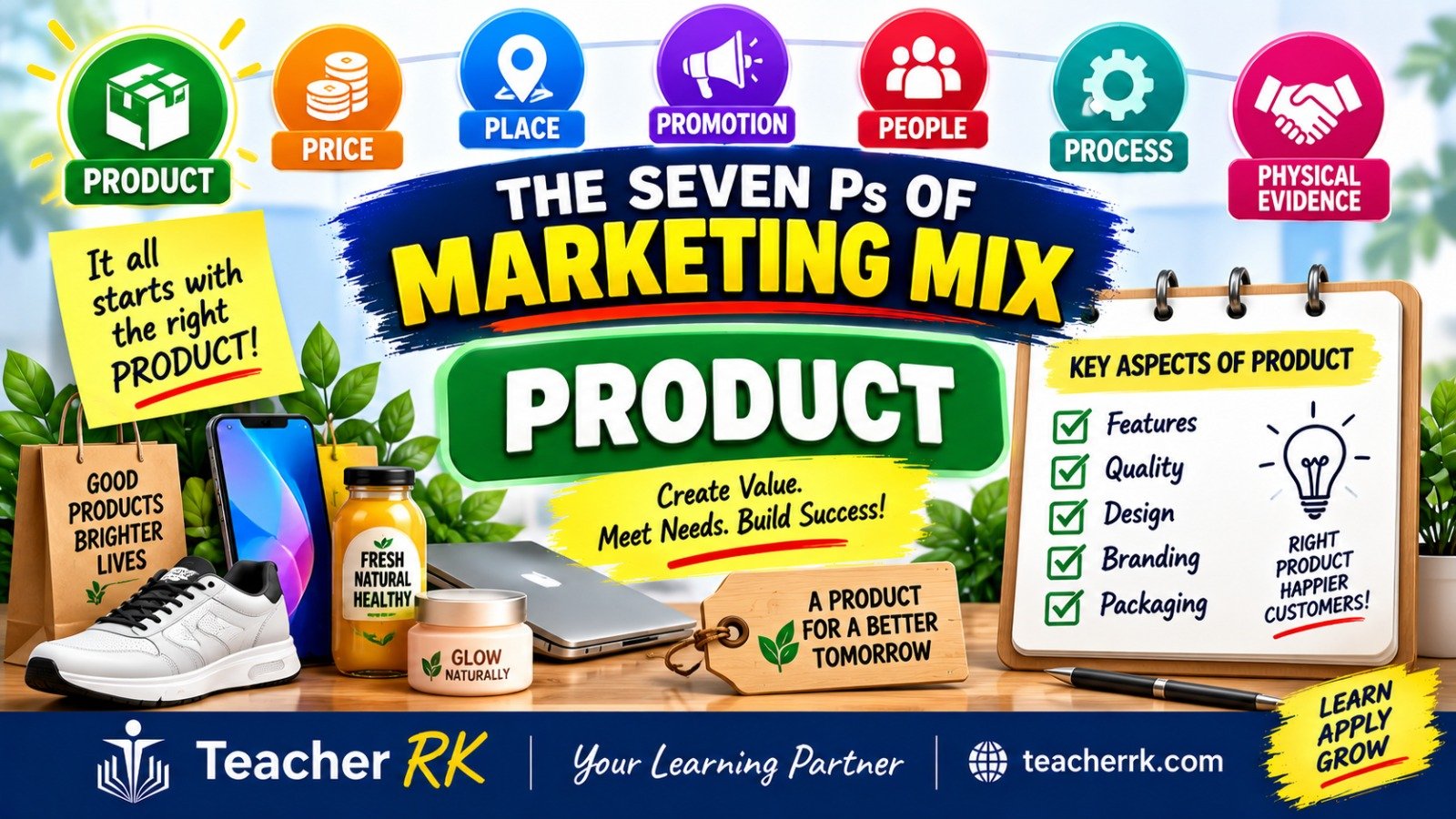
The product in marketing mix. A business exists to provide products that satisfy customer needs and wants. Therefore, understanding the nature of products and how they evolve over time is essential for effective marketing. Businesses must continuously develop, improve, and manage their products to remain competitive and meet changing customer expectations.
Meaning of product
A product is anything offered by a business to satisfy the needs and wants of customers. A product can be a physical good, a service, or a combination of both.
Products are generally classified into two categories:
Tangible products
Tangible products are physical goods that can be seen, touched, and owned. Examples include Smartphones, shoes, furniture, books, etc.
Intangible products
Intangible products are services that cannot be physically touched or owned. Examples include banking services, insurance, education, streaming subscriptions, etc.
Product life cycle (PLC)
The Product Life Cycle (PLC) is a model that shows the stages a product passes through from its development to its eventual decline in the market. Understanding the product life cycle helps businesses make appropriate marketing and investment decisions at each stage.
Product life cycle stages
Stage 1: The Research and Development (R&D) stage
This is the initial phase of the product life cycle where new product ideas are generated, developed, and refined before they are introduced to the market. This stage involves significant investment in time, resources, and creativity to transform a concept into a viable product.
Characteristics
- Innovation and Idea Generation: This phase focuses on brainstorming and generating innovative ideas for new products or improvements to existing products.
- Feasibility Studies: Assessing the technical, economic, and market feasibility of the product idea to determine its potential success.
- Prototyping: Creating prototypes or models of the product to test and refine design and functionality.
- Testing and Validation: Conducting rigorous testing to ensure the product meets quality standards and performs as expected. This may involve lab tests, field tests, and user trials.
- Regulatory Approvals: Ensuring the product complies with relevant regulations and standards, which may involve obtaining certifications or approvals from regulatory bodies.
Stage 2: Introduction Stage:
This is the launch phase where the product is introduced to the market. Marketing and promotional efforts are high to create awareness.
Characteristics: Low sales, high costs, and limited competition.
Focus: Building product awareness and encouraging trial.
Stage 3: Growth Stage:
The product gains acceptance, and sales begin to increase rapidly. The market expands as more customers buy the product.
Characteristics: Increasing sales, rising profits, and growing competition.
Focus: Maximizing market share and improving product features.
Stage 4: Maturity Stage:
The product reaches peak market penetration. Sales growth slows down, and the market becomes saturated.
Characteristics: Stable sales, high competition, and pressure on prices.
Focus: Defending market share and differentiating the product.
Stage 5: Decline Stage:
The product’s sales and profits begin to decline as the market becomes saturated or new innovations emerge.
Characteristics: Decreasing sales, reduced profits, and potential exit of competitors.
Focus: Managing decline, considering discontinuation, or finding ways to rejuvenate the product.
Importance of the product life cycle
- Helps businesses plan marketing strategies.
- Assists in forecasting sales and profits.
- Supports product development decisions.
- Helps identify when products need improvement or replacement.
- Enables better allocation of marketing resources.
Extension Strategies
Extension strategies are techniques businesses use to prolong the life cycle of a product and delay its decline. These strategies are implemented to revitalize a product’s sales and maintain its market presence for a longer period, effectively extending its maturity stage.
Methods:
Product Modification: Updating or improving the product’s features, design, or functionality to attract new customers or retain existing ones.
Examples: Introducing new flavors or variants, improving the quality, or adding new features.
Market Expansion: Entering new geographical markets or targeting new customer segments.
Examples: Expanding into international markets, targeting a different age group, or appealing to a new demographic.
Rebranding: Refreshing the product’s brand image through new packaging, a new logo, or a new marketing campaign.
Examples: Updating the product’s packaging to make it more modern or changing the brand’s messaging to resonate with current trends.
Price Adjustments: Changing the product’s price to attract different customer segments or to compete more effectively in the market.
Examples: Offering discounts, introducing a budget version, or implementing a premium pricing strategy for a higher-end version.
Promotional Activities: Running special promotions, sales campaigns, or advertising efforts to reignite interest in the product.
Examples: Limited-time offers, bundling the product with other items, or increasing advertising efforts on social media.
New Uses for the Product: Finding and promoting new uses or applications for the product to reach different markets.
Examples: Marketing baking soda as a cleaning product or promoting a drink as both a beverage and a cooking ingredient.
Enhanced Customer Engagement: Building stronger relationships with customers through loyalty programs, better customer service, or community building.
Examples: Implementing a rewards program, creating a customer feedback loop, or building a community around the product.
Extension strategies are essential for businesses looking to maximize the profitability and market presence of their products. By creatively adapting and promoting products, companies can sustain interest and sales, effectively delaying the decline phase of the product life cycle.
Relationship between product life cycle, investment, cash flow, and profit
The relationship between the Product Life Cycle (PLC), investment, cash flow, and profit changes as a product moves through its different stages.
1. Research and Development (R&D) Stage
During the Research and Development (R&D) stage, businesses invest heavily in activities such as idea generation, product design, testing, and product development. Since the product has not yet been launched, there are no sales revenues. As a result, cash outflows exceed cash inflows, leading to negative cash flow and negative profits. This stage requires significant investment with no immediate financial returns.
2. Introduction Stage
During the Introduction stage, the product is launched into the market. Businesses continue to invest heavily in advertising, promotion, and distribution to create customer awareness. Sales are usually low, resulting in limited cash inflows. Consequently, cash flow may remain low or negative, and profits are often negative or very low.
3. Growth Stage
During the Growth stage, customer acceptance increases and sales grow rapidly. Although businesses may continue investing in production capacity and marketing, increasing sales generate higher cash inflows. As a result, cash flow becomes positive and profits rise significantly.
4. Maturity Stage
During the Maturity stage, the product reaches peak market acceptance. Sales are high and relatively stable, generating strong cash inflows. Investment levels are generally lower than in earlier stages, allowing businesses to achieve their highest levels of cash flow and profit.
5. Decline Stage
During the Decline stage, sales begin to fall as customer preferences change or newer products enter the market. Businesses typically reduce investment and marketing expenditure. However, declining sales lead to lower cash inflows, causing both cash flow and profits to decrease over time.
Branding
In highly competitive markets, businesses need more than just a good product in marketing mix to succeed. They must create a unique identity that customers can recognize, trust, and remember. Branding helps businesses differentiate their products from competitors and build strong relationships with customers. A strong brand can influence purchasing decisions, create customer loyalty, and add significant value to a business.
Meaning of Branding
Branding is the process of creating a unique name, symbol, design, image, or identity for a product, service, or business that distinguishes it from competitors in the minds of customers.
A brand is more than a logo or a name; it represents the perceptions, experiences, and emotions that customers associate with a business or product.
Examples: Apple, Nike, Coca-Cola, and Samsung are well-known global brands.
Key branding concepts
1. Brand awareness
Brand awareness refers to the extent to which customers recognize and recall a brand. A high level of brand awareness increases the likelihood that customers will consider the brand when making purchasing decisions.
Example: Most consumers can easily recognize the Nike logo or Apple’s logo.
2. Brand loyalty
Brand loyalty refers to the tendency of customers to repeatedly purchase a particular brand over time. Loyal customers are less likely to switch to competing brands, even when alternatives are available.
Example: Customers who consistently purchase iPhones instead of competing smartphones.
3. Brand development
Brand development is the process of strengthening and expanding a brand over time by improving customer perceptions, increasing brand recognition, and extending the brand into new markets or product in marketing mix categories.
Example: Nike expanding from sports footwear into apparel and fitness products.
4. Brand Value
Brand value refers to the financial and strategic worth of a brand to a business. Strong brands often allow businesses to charge premium prices and generate higher revenues.
Example: The Apple brand contributes significantly to the company’s market value and profitability.
Importance of Branding
Creates product differentiation: Branding helps businesses distinguish their products and services from those of competitors.
Increases customer recognition: Strong branding makes it easier for customers to identify and remember a product in marketing mix or business.
Builds customer loyalty: Customers are more likely to make repeat purchases from brands they trust and value.
Supports premium pricing: Well-established brands can often charge higher prices because customers perceive greater value.
Enhances business value: A strong brand becomes a valuable intangible asset that contributes to the long-term success and profitability of a business.
Branding is the process of creating a unique identity for a product, service, or business. Key branding concepts include brand awareness, brand loyalty, brand development, and brand value. Effective branding helps businesses differentiate themselves, attract and retain customers, support premium pricing, and build long-term business value.
Chapter Snapshot
1. A product is anything offered by a business to satisfy customer needs and wants.
2. Products can be tangible (physical goods) or intangible (services). Tangible products can be seen and touched, whereas intangible products cannot be physically possessed.
3. The Product Life Cycle (PLC) shows the stages a product passes through from development to eventual decline in the marketplace.
4. The first stage of the PLC is Research and Development (R&D), where businesses invest in idea generation, product design, testing, and development before launch.
5. During the Introduction stage, sales are low, promotional costs are high, and profits are often low or negative.
6. During the Growth stage, sales and profits increase rapidly as customer awareness and market acceptance grow.
7. During the Maturity stage, sales reach their highest level, competition intensifies, and profits stabilize.
8. During the Decline stage, sales and profits decrease due to changing customer preferences, technological advancements, or increased competition.
9. Investment is highest during the R&D and Introduction stages, while cash flow and profits are generally highest during the Maturity stage.
10. Branding is the process of creating a unique identity for a product in marketing mix or business. Strong brands increase brand awareness, encourage brand loyalty, and enhance brand value, helping businesses attract and retain customers.