
Introduction
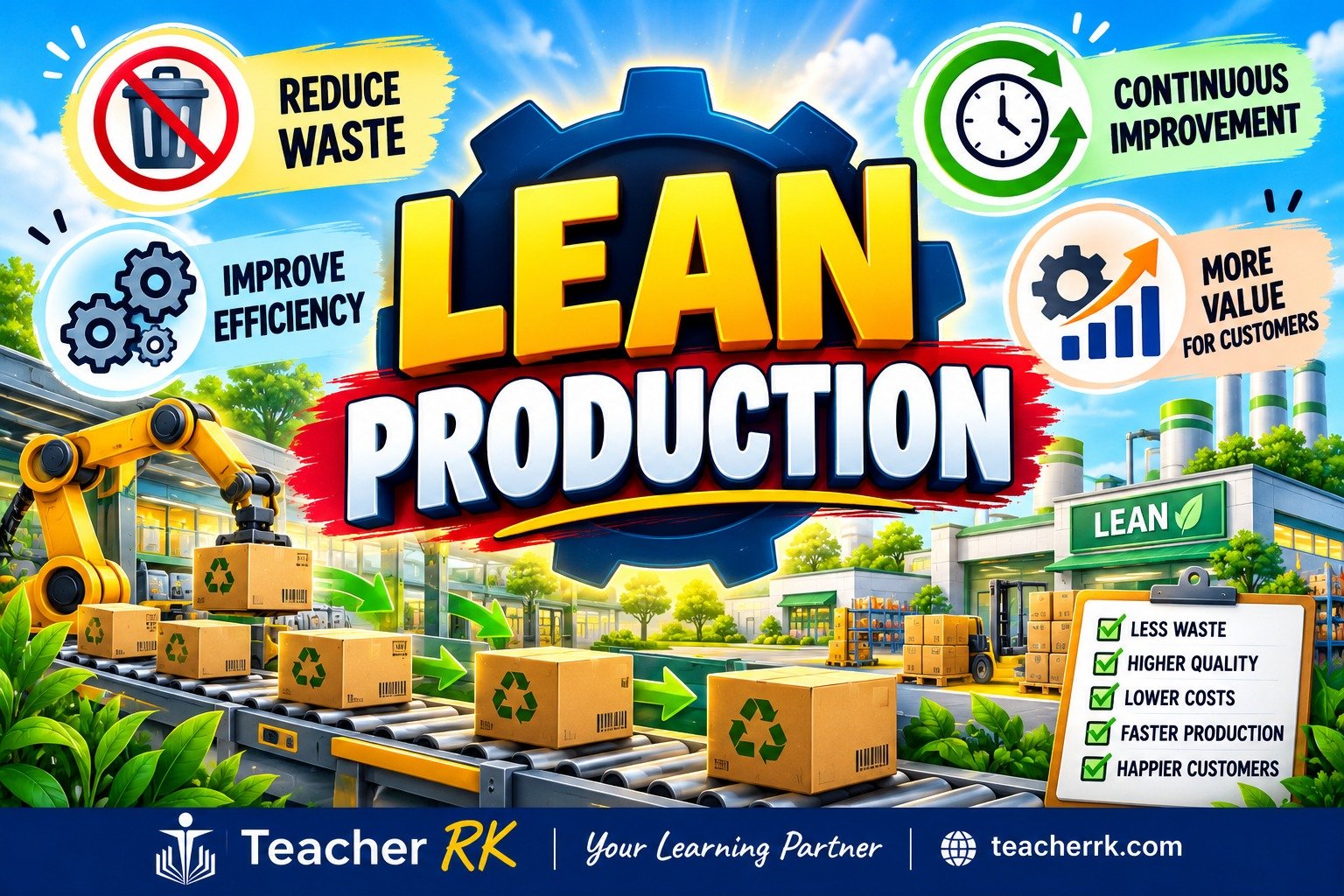
In today’s highly competitive business environment, businesses aim to produce high-quality products while minimizing costs and eliminating waste. To achieve this, many organizations adopt lean production, a production approach that focuses on improving efficiency, reducing waste, and delivering greater value to customers. Lean production helps businesses improve productivity, quality, and customer satisfaction.
Meaning of lean production
Lean production is a Japanese production approach that aims to maximize customer value while minimizing waste. It focuses on using resources efficiently, improving quality, reducing costs, and continuously improving production processes.
Features of lean production
· Eliminates waste and non-value-adding activities.
· Focuses on continuous improvement.
· Produces high-quality products with minimal defects.
· Uses resources efficiently to reduce costs.
· Responds quickly to customer demand.
Methods of lean production
Continuous Improvement (Kaizen)
Continuous improvement (Kaizen) is a lean production method that focuses on making small, ongoing improvements to products, processes, and work practices. It encourages all employees to identify problems and suggest ways to improve efficiency, quality, and productivity.
Examples
· Employees suggest ways to reduce production time.
· Rearranging equipment to improve workflow.
· Regular quality improvement meetings.
| Advantages | Disadvantages |
| · Improves product quality.· Reduces waste and production costs.· Encourages employee involvement and teamwork. | · Improvements may take time to produce significant results.· Requires continuous employee commitment.· Frequent changes may face resistance from employees |
Just-in-Time (JIT)
Just-in-Time (JIT) is a lean production method in which materials and components are purchased or produced only when they are needed in the production process. This minimizes inventory levels and reduces storage costs.
Examples
· Toyota receives car parts from suppliers shortly before they are needed on the assembly line.
· A bakery orders fresh ingredients daily based on expected customer demand.
| Advantages | Disadvantages |
| · Reduces inventory holding costs.· Minimizes waste from excess stock.· Improves cash flow by reducing money tied up in inventory. | · Production may stop if suppliers fail to deliver on time.· Businesses are more vulnerable to supply chain disruptions.· Requires highly reliable suppliers and accurate demand forecasting. |
Just-in-Time (JIT) vs Just-in-Case (JIC)
| Just-in-Time (JIT) is an inventory management approach in which materials and components are received or produced only when they are needed in the production process. This helps businesses reduce inventory levels, storage costs, and waste. However, JIT relies heavily on accurate demand forecasting and reliable suppliers, as any delay in deliveries can disrupt production | Just-in-Case (JIC) is an inventory management approach in which businesses maintain extra stock to prepare for unexpected increases in demand or supply chain disruptions. Although JIC reduces the risk of stock shortages and production delays, it results in higher inventory holding costs and more money being tied up in stock. |
Lean production helps businesses improve efficiency by eliminating waste and continuously improving processes. Kaizen promotes ongoing incremental improvements through employee involvement, while Just-in-Time (JIT) reduces inventory by receiving materials only when they are needed. Together, these methods help businesses lower costs, improve quality, and respond more effectively to customer demand.
| Remember:· JIT = Low Inventory + Low Cost + Higher Risk· JIC = High Inventory + Higher Cost + Lower Risk |








One Comment