
Table of Contents
| Topics covered:· Reasons for a specific location of production· Ways of reorganising production -outsourcing, offshoring, insourcing, and reshoring· Operations management- key functions |
Introduction
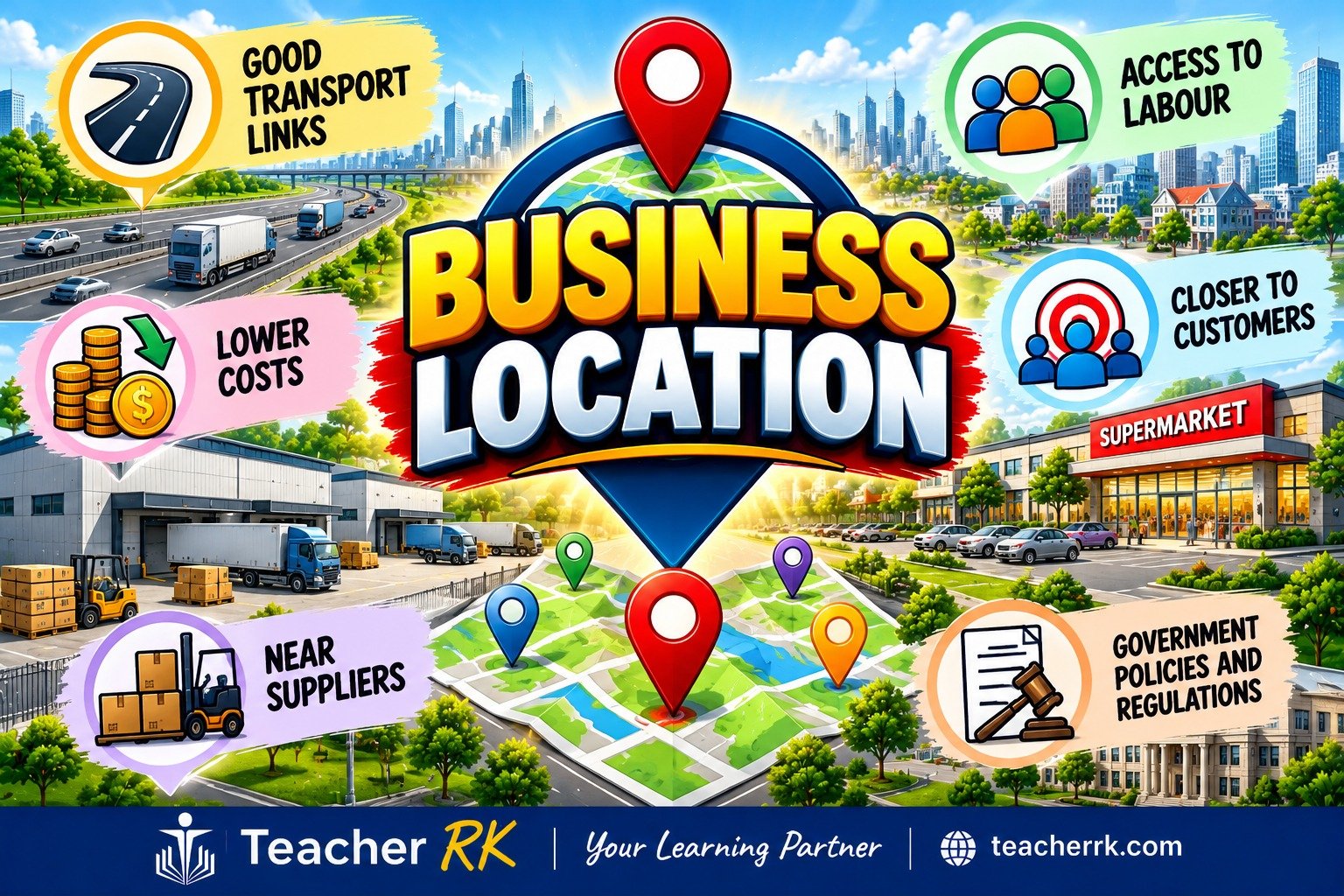
Choosing the right location is one of the most important decisions a business locations makes. A suitable location of business can help to reduce costs, attract customers, access skilled employees, and improve profitability. The best location depends on factors such as the nature of the business, target market, availability of resources, and operating costs. Before selecting a location, businesses carefully evaluate both qualitative and quantitative factors.
Factors influencing business locations
Businesses locations consider a variety of factors before deciding where to locate their operations. These factors can be broadly classified into qualitative factors and quantitative factors.
Qualitative factors
Qualitative factors are non-financial factors that cannot be easily measured in monetary terms but can significantly influence business success.
Availability of skilled labour
Businesses often locate where they can recruit employees with the required skills and experience. Access to a skilled workforce improves productivity, product quality, and customer service.
Proximity to Customers
Locating close to customers/market can improve convenience, reduce delivery times, and increase sales. Retail stores, restaurants, and service businesses often choose locations with high customer traffic.
Government policies and regulations
Government incentives such as tax concessions, grants, or relaxed regulations may encourage businesses to locate in certain regions. Businesses must also consider environmental and zoning regulations.
Availability of infrastructure
Good transport links, reliable electricity, water supply, internet connectivity, and communication facilities enable businesses to operate efficiently and serve customers effectively.
Quantitative factors
Quantitative factors are financial factors that can be measured and compared using numerical data.
Land and building costs: The cost of purchasing or renting land and buildings varies by location. Businesses aim to select locations that offer suitable facilities at an affordable cost.
Labour costs: Wages and employee benefits differ across regions. Businesses often compare labour costs to reduce operating expenses while maintaining productivity.
Transportation costs: Businesses consider the cost of transporting raw materials to the business and delivering finished products to customers. Lower transportation costs help improve profitability.
Utility costs: The cost of electricity, water, gas, and internet services can significantly affect operating expenses. Businesses generally prefer locations with reliable and reasonably priced utilities.
Quick summary
| Quantitative factors | Qualitative factors |
| · Availability, suitability and cost of land | · Management preferences |
| · Availability, quality and cost of labour | · Local knowledge |
| · Proximity to the market ( customer) | · Infrastructure |
| · Proximity and access to raw materials | · Government restrictions and regulations |
| · Government incentives and regulations | · Political stability |
| · Feasibility of ecommerce | · Ethical issues |
| · Comparative shopping (clustering) |
Selecting the right business location is a strategic decision that affects costs, efficiency, customer satisfaction, and long-term success. Businesses must carefully evaluate both qualitative factors, such as labour availability and customer access, and quantitative factors, such as land, labour, transportation, and utility costs, before making a location decision.
Ways of Reorganising Production
As businesses grow and face increasing competition, they often reorganise their production activities to improve efficiency, reduce costs, access specialised expertise, and respond to changing market conditions. Four common ways of reorganising production are outsourcing, offshoring, insourcing, and reshoring. Each approach offers different advantages depending on the business’s objectives.
Outsourcing
Outsourcing is the practice of hiring an external company to perform specific business activities or production processes that were previously carried out within the business location.
Examples:
· Hiring a third-party company to provide customer support.
· Outsourcing payroll or IT services.
· Contracting another manufacturer to produce components.
Advantages and Disadvantages of Outsourcing
| Advantages | Disadvantages |
| 1. Cost reduction 2. Access to specialized skills 3. Focus on core activities 4. Increased efficiency 5. Flexibility in operations | 1. Loss of control 2. Quality issues 3. Communication problems 4. Data security risks 5. Dependence on external firms |
Offshoring
Offshoring involves relocating business operations or production activities to another country, usually to reduce costs or access specialised skills and resources.
Examples:
- An American company manufacturing products in Vietnam.
- A UK business operating a customer service centre in India.
Insourcing
Insourcing is the process of bringing business activities or production processes back into the organisation instead of relying on external suppliers or contractors.
Examples:
- A company establishes its own IT department instead of outsourcing IT services.
- A manufacturer begins producing components internally rather than purchasing them from suppliers.
Reshoring
Reshoring is the process of bringing production or business operations back to the company’s home country after previously offshoring them to another country.
Examples:
- A UK manufacturer moves production from China back to the United Kingdom.
- A US company relocates its manufacturing facilities from Mexico back to the United States.
Businesses reorganise production to improve efficiency, reduce costs, enhance quality, and respond to changing market conditions. Outsourcing transfers activities to external firms, offshoring relocates operations to another country, insourcing brings activities back within the business, and reshoring returns production to the home country. Choosing the most appropriate approach depends on the business’s strategic objectives, costs, quality requirements, and customer expectations.
Quick Recap
1. Business location is the place where a business operates or carries out its activities, and choosing the right location for business can improve efficiency, customer access, and profitability.
2. Qualitative factors are non-financial factors, such as the availability of skilled labour, proximity to customers, government policies, and infrastructure.
3. Quantitative factors are measurable financial factors, including land and building costs, labour costs, transportation costs, and utility costs.
4. Outsourcing is the practice of hiring an external business to perform specific activities or production processes.
5. Offshoring involves relocating production or business operations to another country, often to reduce costs or access skilled labour.
6. Insourcing is the process of bringing previously outsourced activities back within the business.
7. Reshoring refers to bringing production or business operations back to the company’s home country after they have been offshored.
8. Businesses reorganise production to reduce costs, improve efficiency, enhance quality, and remain competitive.
9. Each method of reorganising production has its own advantages and challenges, so businesses must select the option that best supports their strategic objectives.
10. Choosing the right business locations and production strategy can improve operational efficiency, customer satisfaction, and long-term business success.