Table of Contents
Meaning
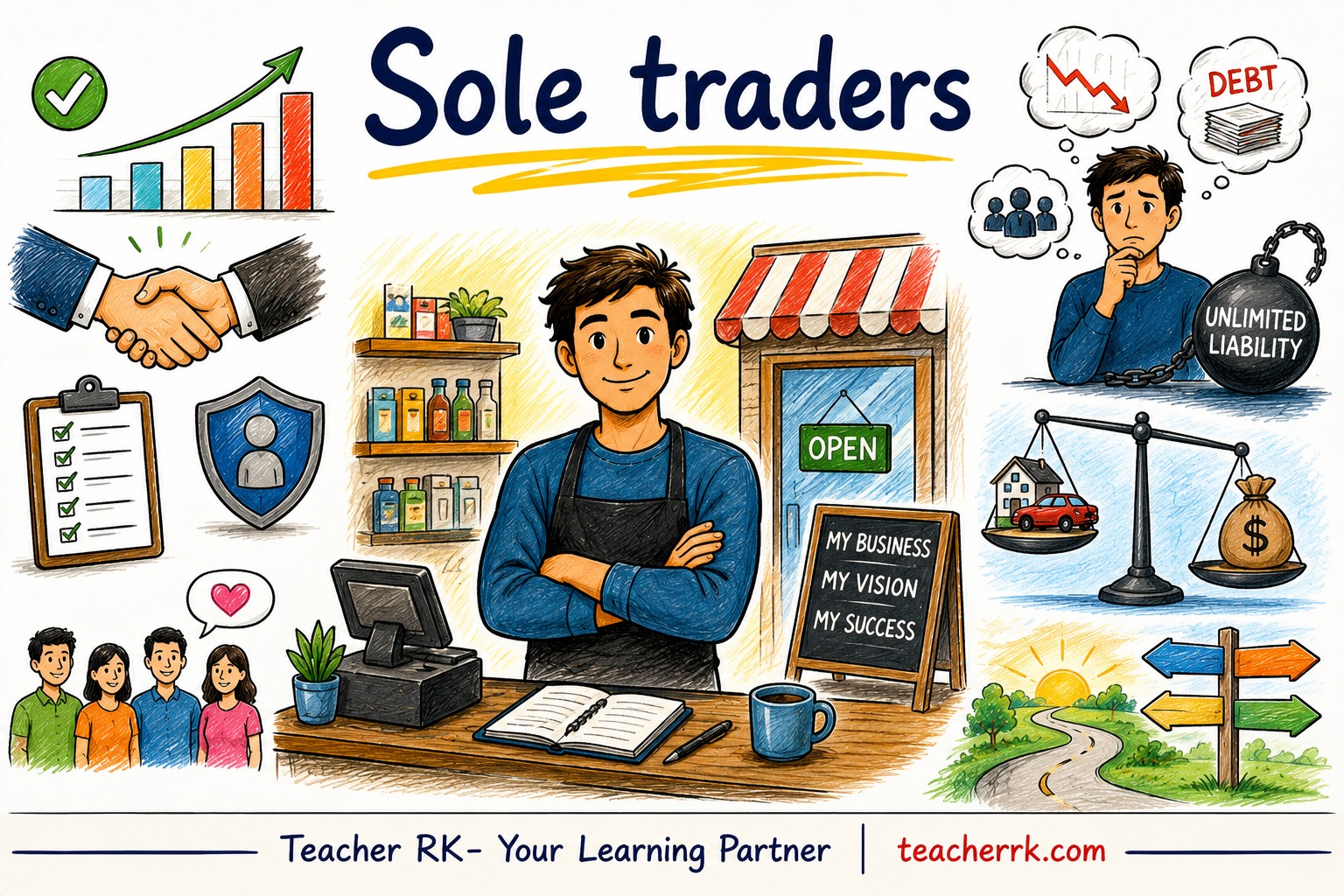
A sole trader is a business owned, managed, and controlled by one individual. It is the simplest and most common form of business ownership. The owner is responsible for all business decisions and is entitled to all profits, but also bears all losses and liabilities.
Features of a sole trader
· Single owner
· Full control over decision-making
· Unlimited liability
· Receives all profits
· Easy to establish and operate
| Advantages of a sole trader | Disadvantages of a Sole Trader |
| 1. Easy to start: A sole proprietorship requires minimal legal formalities and can be established quickly. 2. Full control: The owner has complete authority to make business decisions without consulting others. 3. Retains all profits: All profits earned by the business belong to the owner. 4. Greater flexibility: The owner can quickly adapt to changes in customer preferences and market conditions. 5. Strong customer relationships: Direct interaction with customers often helps build trust and loyalty. | 1. Unlimited liability: The owner is personally responsible for all business debts and obligations. 2. Limited capital: Raising funds can be difficult because the business depends mainly on the owner’s resources. 3. Heavy workload: The owner is responsible for managing all aspects of the business. 4. Limited Expertise: One person may not possess all the skills needed for effective business management. 5. Lack of continuity: The business may cease to exist if the owner retires, becomes incapacitated, or passes away. |
Meaning of unlimited liability
Unlimited liability means that the owner of a business is personally responsible for all the debts and obligations of the business. If the business cannot pay its debts, the owner’s personal assets, such as savings, car, or house, may be used to repay creditors.
Example:
Regi owns a small grocery store as a sole trader. His business owes $50 000 to suppliers, but the Reasons for starting a business assets are worth only $ 30 000. Since Regi has unlimited liability, he must use his personal savings or sell personal assets to pay the remaining $ 20 000 debt.
Under unlimited liability, there is no legal distinction between the owner’s personal finances and the business’s debts.
Quick Recap
1. The private sector consists of businesses owned and controlled by individuals or private organizations, while the public sector consists of organizations owned and managed by the government.
2. The primary objective of the private sector is to earn profits, whereas the public sector aims to provide essential services and promote public welfare.
3. The public sector exists to provide essential public services, promote social welfare, ensure national security, correct market failures, and support economic development.
4. A sole trader is a business owned, managed, and controlled by one individual.
5. A sole trader enjoys full control over decision-making and retains all the profits earned by the IB business management assessment structure.
6. A major disadvantage of a sole trader is unlimited liability, meaning the owner is personally responsible for all business debts.
7. Other disadvantages of a sole trader include limited capital, heavy workload, limited expertise, and lack of business continuity.
8. A key advantage of a sole trader is that it is easy to establish, flexible to manage, and allows quick decision-making.
9. Unlimited liability means there is no legal distinction between the owner’s personal assets and the business’s debts.
10. Choosing the right business ownership structure depends on factors such as risk, control, capital requirements, and business objectives.
| Useful links: Worksheet Case study Classroom activity |