Table of Contents
Introduction
Every business has to effectively utilize its resources and activities to meet the customers’ needs and attain its objectives. Operations management acts as a key component in the planning, organizing and controlling of the processes used in production of goods or services. Whether it is a manufacturer of smart phones or a restaurant offering food services, every business requires effective operations to transform inputs like labor, raw materials, capital and technology into outputs.
The concept of operations management is broader than just production of goods or services. This means management of the resources, maintenance of quality, cost control, productivity improvement and delivery of goods and services on time. Effective operations management allows businesses to use their resources effectively, minimize waste and increase overall performance.
Knowledge of what is operations management is all about is essential to the students and businesses since it helps in understanding the manner in which organizations carry out their everyday production or service processes.
What is Operations Management ?
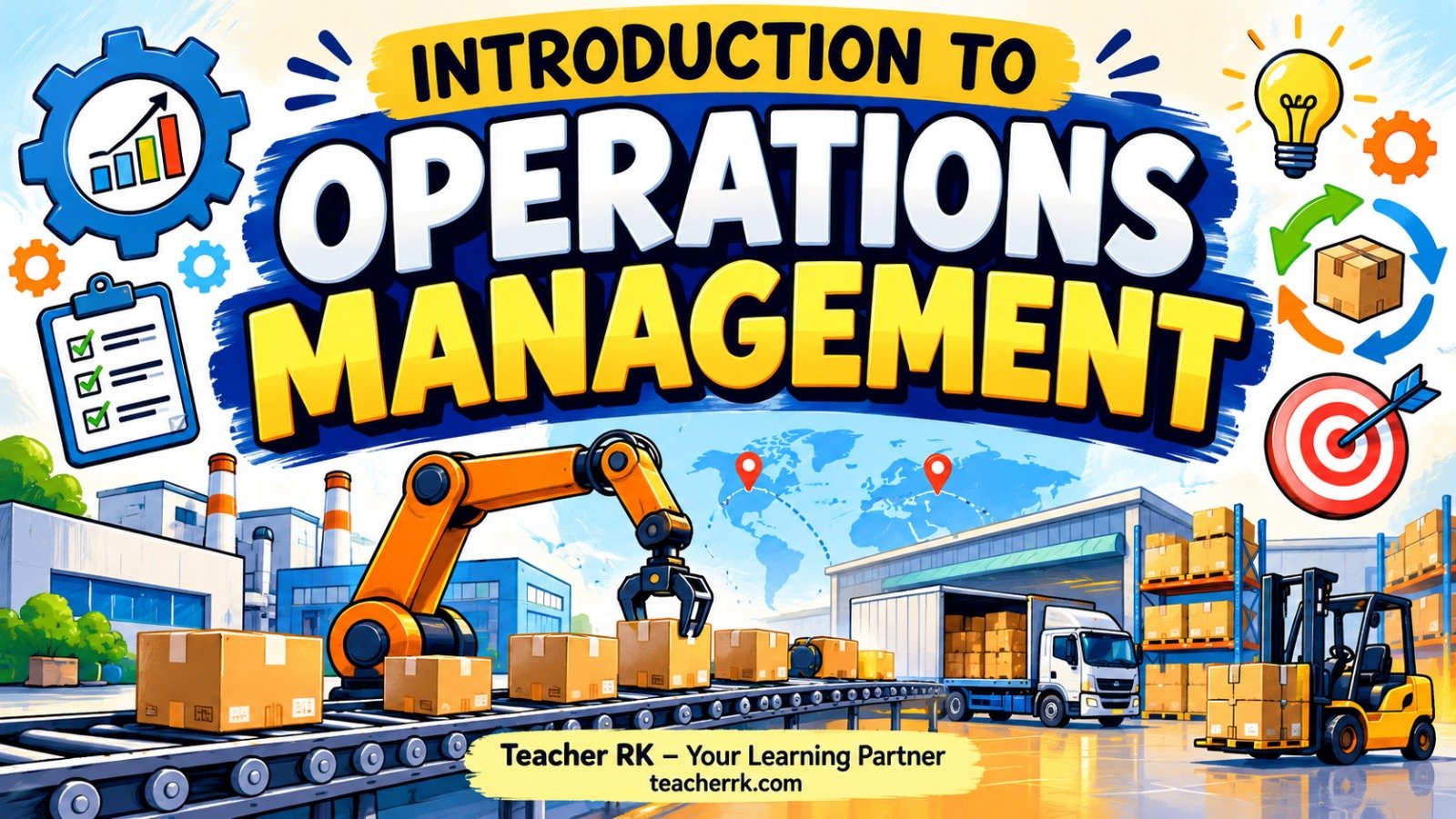
Operations management refers to the planning, organizing, coordinating, and controlling of the resources and processes involved in producing goods and services. It focuses on transforming inputs such as labour, materials, capital, and technology into outputs that satisfy customer needs.
Example
A furniture manufacturer uses wood, machinery, and workers (inputs) to produce tables and chairs (outputs). Similarly, a restaurant uses ingredients, chefs, and equipment to provide meals and dining services.
Importance of Operations Management
· Improves productivity: Efficient operations help businesses produce more output using the same or fewer resources.
· Reduces costs: Effective management of resources minimizes waste and lowers production costs.
· Ensures product and service quality: Operations management solutions helps maintain consistent quality standards, leading to higher customer satisfaction.
· Improves customer satisfaction: Producing the right product at the right time and quality level helps meet customer expectations.
· Supports business objectives: Efficient operations contribute to profitability, growth, and long-term business success.
· Enhances competitive advantage: Businesses with efficient operations can offer better quality, lower prices, or faster delivery than competitors.
· Optimizes resource utilization: Operations management ensures that labour, machinery, materials, and technology are used effectively.
Key functions of operations management
Planning of Production Activities
Operations management solutions is about planning the product or service to be produced, the quantity to be produced, and the time of production. Proper planning can prevent delays and ensure the availability of resources.
Management of Resources
The operation management deals with the management of resources such as labor, raw material, machines, technology, and finance. It ensures the efficient use of the available resources and avoids wastage of any kind.
Quality Maintenance
Operations management assists in the maintenance of quality standards of the products and services through proper setting and monitoring of quality standards.
Cost Control
Cost control means avoiding unnecessary expenditure and wastage and proper utilization of resources. This is important for keeping down costs and staying profitable while providing quality products and services.
Inventory Management
Inventory management is the process of keeping track of raw material, work-in-process, and finished goods inventory. This will help in avoiding inventory shortage, inventory surplus, and costs of inventory holding.
Enhancing Efficiency and Productivity
The focus of the operations management is improvement in processes which enable businesses to increase the output with the available inputs. Efficient processes, technology, and resource utilization lead to higher productivity and efficiency.
Ensuring Timely Delivery of Goods and Services
Operations management ensures that products and services are completed and delivered according to the required schedule. Timely delivery helps businesses meet customer expectations and maintain smooth operations.
The operations department works closely with other functional areas of the business. It collaborates with the Human Resources (HR) department to recruit and train employees needed for production and service delivery. It works with the finance department to secure funding for machinery, equipment, and raw materials, as well as to control production costs. The marketing department provides information about customer needs and sales forecasts, helping operations plan production levels and ensure that products are available when customers demand them. Effective coordination between these departments helps improve efficiency
Types of Operations Management
There exist several approaches to the operations management practice based on the purposes of business, character of its activity and degree of control necessary. The most popular among them are objective management, task management and supervision of individuals.
Objective Management
Objective management is aimed at setting priorities and making decisions about the operations in accordance with the general objectives of the company. This approach ensures that all operations are directed at achieving the desired objectives related to efficiency, cost control, quality and customers’ satisfaction.
Task Management
Task management is aimed at organization and monitoring of the activities which are necessary for completion of operations. Managers allocate tasks, control ongoing process, manage workflow and make sure that all activities are conducted in an efficient way.
Individual Supervision
Individual supervision is aimed at monitoring of employees and their activities to make sure that all operations are conducted properly. Managers use information provided by the employees to identify possible problems and conduct operations smoothly.
Operations Management Process
The operations management process entails the conversion of inputs into outputs by means of a number of well-planned and controlled activities. It assists firms in managing their resources, conducting production/service activities, ensuring quality, and delivering their products/services to consumers.
This process may be illustrated by the following steps:
Inputs
Inputs refer to the resources needed to manufacture a good or deliver a service. They could be raw materials, labor, capital, equipment, technology, information, among others.
Transformation Process
This is the stage where inputs are transformed into goods or services through production/operational activities. This may include manufacturing, assembly, processing, transportation, or delivering a service.
Outputs
These are the final goods or services manufactured or delivered by a firm. In the case of furniture company, for instance, its outputs would include tables and chairs, while those of a restaurant will include food services.
Feedback and Control
Firms monitor their outputs and obtain feedback in order to identify problems and areas that need improvements. The management can then take necessary measures to enhance quality, efficiency, productivity, and customer satisfaction.
Role of Operations Management in Business
Operations management has a significant impact on the way that business activities are conducted efficiently and effectively. It integrates the resources, personnel, processes, and technology of organizations to create goods and services to meet customers’ needs.
Major functions of operations management are:
Increasing Productivity
Operations management assists organizations to increase productivity by using the available resources, labor, material, machines, and technologies more efficiently.
Maintaining High Quality Standards
It helps businesses to maintain quality standards in production and service processes.
Minimizing Operating Costs
Operations management helps businesses minimize production and operation costs by reducing waste and optimizing resource utilization.
Satisfying Customer Needs
Operations management helps businesses to meet customers’ needs for products and services in terms of their quality, quantity, and time.
Effective Resource Management
It helps businesses to use the resources including employees, raw materials, equipment, money, and technologies effectively.
Growth of Business
Operations management helps businesses to meet growing demands and to achieve high profitability and sustainable development.
Quick recap
1. Operations management is the process of planning, organizing, and controlling the production of goods and services.
2. The main role of operations management solutions is to transform inputs into outputs efficiently.
3. Inputs include resources such as labour, raw materials, capital, and technology.
4. Outputs are the goods and services produced by a business.
5. The operations process can be represented as Inputs → Process → Outputs.
6. Effective operations management helps improve productivity by producing more output with available resources.
7. Operations management helps reduce costs by minimizing waste and improving efficiency.
8. Maintaining high product and service quality is an important responsibility of the operations department.
9. The operations department works closely with HR to recruit and train employees, Finance to obtain funding and control costs, and Marketing to understand customer needs and forecast demand.
10. Efficient operations management contributes to customer satisfaction, profitability, and competitive advantage. and achieve business objectives.
FAQs About Operations Management
1. What is operations management?
Operations management is the process of planning, organizing, and controlling business activities to produce goods or deliver services efficiently. It involves managing resources, maintaining quality, controlling costs, and improving productivity to meet customer needs and achieve business objectives.
2. What is operational management, and why is it important?
Operational management refers to managing the day-to-day activities and processes of a business. It is important because it helps organizations improve efficiency, reduce operational costs, maintain quality standards, optimize resources, and deliver products or services on time.
3. What are the main functions of operations management?
The main functions of operations management include production planning, resource allocation, inventory management, quality control, cost management, process improvement, and timely delivery. These functions help businesses use available resources effectively and maintain smooth operations.
4. What are operations management solutions?
Operations management solutions are strategies, tools, and software used to improve business processes, manage inventory, monitor performance, control costs, and coordinate resources. Examples include inventory management systems, production planning software, workflow automation, and supply chain management tools.
5. What is the difference between operations and operations management?
Operations refer to the activities a business performs to produce goods or deliver services. Operations management is the process of planning, coordinating, monitoring, and improving those activities to ensure efficiency, quality, productivity, and customer satisfaction.