
Table of Contents
Introduction
Planning and controlling finances are essential for the success of any business. To achieve financial objectives and use resources effectively, businesses prepare budgets and monitor actual performance against planned targets. Budgeting helps businesses allocate resources efficiently, while variance analysis helps identify areas where performance differs from expectations.
Meaning of budget
A budget is a financial plan that estimates the expected revenues, costs, and expenditures of a business over a specific period of time. It serves as a roadmap for managing resources and achieving organizational objectives.
Importance of Budgets
· Supports Planning: Budgets help businesses plan future activities by estimating revenues, costs, and resource requirements.
· Improves resource allocation: They help managers allocate financial resources efficiently among different departments and projects.
· Facilitates control: Budgets provide targets against which actual performance can be measured and monitored.
· Aids decision-making: Budget information helps managers make informed decisions regarding spending, investments, and business operations.
· Enhances coordination: Budgets encourage communication and coordination among different departments, ensuring that everyone works toward common objectives.
Meaning of variance
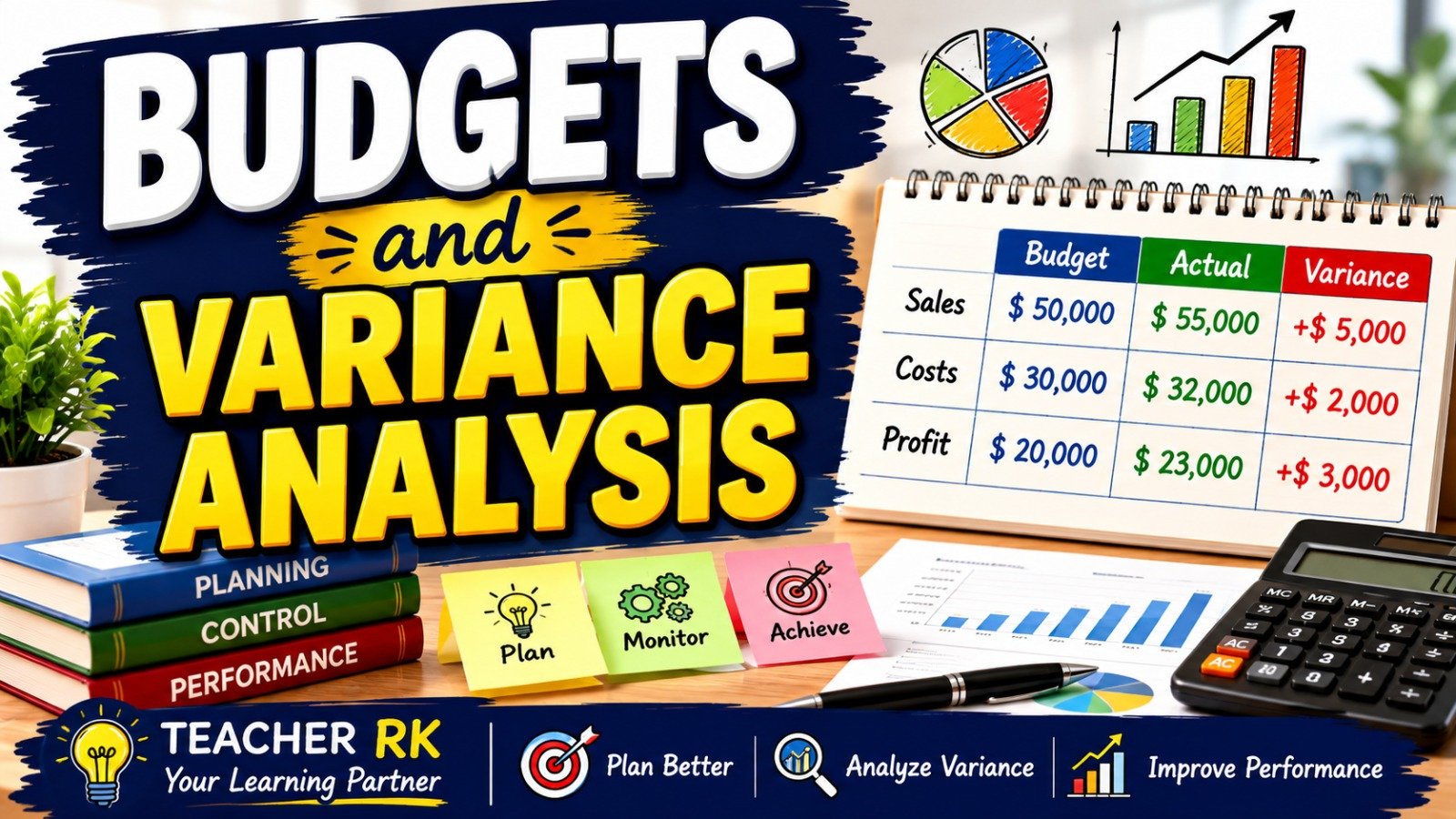
A variance is the difference between the budgeted (planned) figure and the actual figure achieved by the business. Variance analysis helps managers identify deviations from the budget and take corrective action when necessary.
| Formula: Variance = Actual Figure − Budgeted Figure |
Favourable Variance
A favourable variance occurs when actual performance is better than budgeted performance.
Examples
- Actual revenue is higher than budgeted revenue.
- Actual costs are lower than budgeted costs.
- Actual profit exceeds budgeted profit.
Example:
A business budgeted sales revenue of $50,000 but achieved actual sales revenue of $55,000.
Variance = $55,000 − $50,000 = $5,000 favourable
Unfavourable Variance
An unfavourable variance occurs when actual performance is worse than budgeted performance.
Examples
· Actual revenue is lower than budgeted revenue.
· Actual costs are higher than budgeted costs.
· Actual profit is lower than budgeted profit.
Example:
A business budgeted wages of $10,000 but incurred actual wages of $12,000.
Variance = $12,000 − $10,000 = $2,000 unfavourable
This, budgets help businesses plan and control their finances, while variance analysis helps managers evaluate performance by comparing actual results with planned targets. Identifying favourable and unfavourable variances enables businesses to improve decision-making and take corrective action when necessary.
Quick Recap
1. A budget is a financial plan that estimates the expected revenues, costs, and expenditures of a business for a specific period.
2. Budgets help businesses plan future activities, allocate resources efficiently, monitor performance, support decision-making, and improve coordination.
3. A variance is the difference between the actual result and the budgeted (planned) result.
Formula: Variance = Actual Figure − Budgeted Figure
4. Variance analysis compares actual performance with budgeted performance to identify differences and improve future decision-making.
5. A favourable variance occurs when actual performance is better than planned, such as higher revenue, lower costs, or higher profit.
6. An unfavourable variance occurs when actual performance is worse than planned, such as lower revenue, higher costs, or lower profit.
7. Budgets act as a financial control tool, helping managers monitor business performance and achieve organizational objectives.
8. Variance analysis enables businesses to identify problems early and take corrective action before they become more serious.
9. Budgets are estimates, so actual results may differ due to factors such as changing market conditions, inflation, or unexpected events.
10. Budgeting and variance analysis work together to improve financial planning, cost control, operational efficiency, and overall business performance.