Table of Contents
Introduction
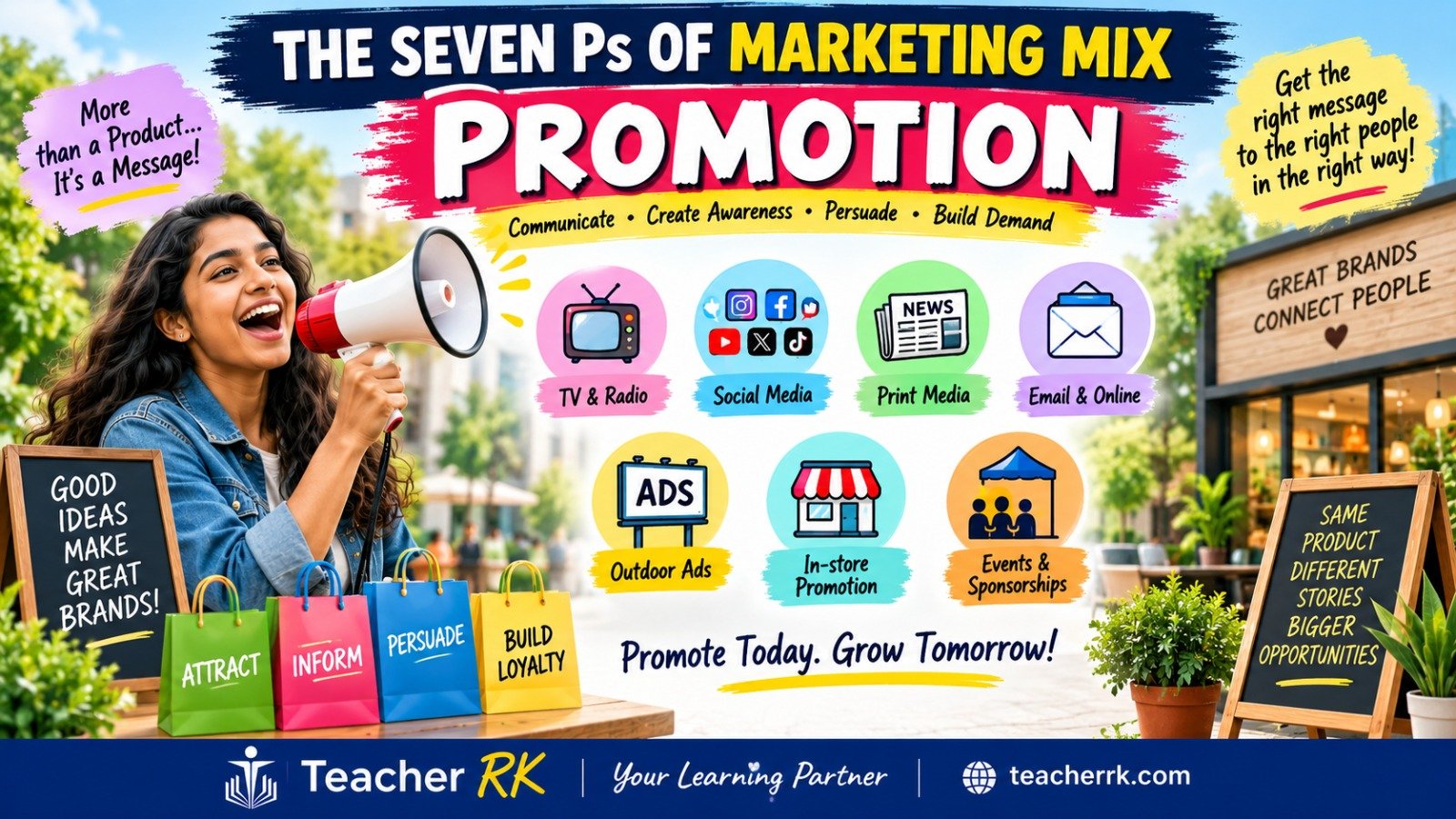
Even the best products may fail if customers are unaware of their existence or benefits. Businesses therefore use promotion mix to communicate with customers, build awareness, generate interest, and encourage purchases. Promotion is an important element of the marketing mix because it helps businesses connect with their target market and achieve their marketing objectives.
What is promotion mix
Promotion mix meaning refers to the communication activities used by a business to inform, persuade, and remind customers about its products, services, or brand. Promotion mix helps businesses create awareness, influence customer attitudes, and encourage purchasing decisions.
Examples of promotional activities include:
- Advertising
- Sales promotions
- Public relations
- Personal selling
- Social media marketing
- Sponsorships
Purpose of promotion
· Create awareness: Promotion mix informs potential customers about the existence of a product, service, or brand. Example: A new restaurant uses social media advertisements to introduce itself to local customers.
· Build brand image: Promotion helps create and strengthen a positive brand image in the minds of customers. Example: Nike uses inspirational advertisements to reinforce its brand identity.
· Inform customers: Businesses use promotion to communicate product features, benefits, prices, and special offers. Example: A smartphone company advertises the features of its latest model.
· Persuade customers: Promotion mix can influence customer preferences and encourage them to choose one brand over another. Example: A car manufacturer highlights superior safety features to attract buyers.
· Remind customers Promotion mix helps keep existing products and brands in customers’ minds. Example: Coca-Cola regularly advertises its products even though the brand is already well known.
· Increase sales: Promotional activities encourage customers to purchase products and services. Example: A retailer offers a “Buy One Get One Free” promotion to boost sales.
Thus, promotion mix is the communication element of the marketing mix promotion. It involves informing, persuading, and reminding customers about products, services, and brands. Effective promotion helps businesses create awareness, build brand image, increase sales, and maintain customer loyalty.
| One-Liner: Promotion helps businesses create awareness, inform customers, persuade them to buy, build brand reputation, remind customers, and increase sales. |
Above-the-Line (ATL) Promotion
Above-the-Line (ATL) promotion refers to mass marketing activities that use traditional paid media channels to reach a large audience. The aim is to create widespread brand awareness and communicate with a broad market rather than targeting specific individuals.
Examples of ATL Marketing
· Television advertisements
· Radio advertisements
· Newspaper advertisements
· Magazine advertisements
· Billboard advertising
For example, A soft drink company launches a television advertising campaign during a major sporting event to reach millions of viewers across the country.
Features of Above-the-Line (ATL) promotion
· Uses paid mass media channels such as television, radio, newspapers, magazines, and billboards.
· Targets a large audience rather than specific customer groups.
· Primarily aims to create brand awareness and build brand image.
· Communication is generally one-way, with limited direct interaction between the business and customers.
| Advantage | Disadvantages |
| 1. Reaches a large audience: ATL promotion uses mass media such as television, radio, and newspapers, allowing businesses to reach millions of potential customers quickly.· 2. Builds brand awareness: Repeated exposure through mass media helps customers recognize and remember the brand, strengthening its market presence. | 1. Expensive: Advertising through television, radio, and national newspapers can be very costly, making it difficult for smaller businesses to afford.· 2. Limited targeting: ATL promotion reaches a broad audience, including many people who may not be interested in the product, reducing the efficiency of the campaign. |
Below-the-Line (BTL) Promotion
Below-the-Line (BTL) promotion refers to promotional activities that target specific groups of customers rather than the mass market. BTL promotion focuses on direct communication and personalized interactions to encourage customer engagement and sales.
Examples of BTL Promotion
· Sales promotions (discounts, coupons, buy-one-get-one-free offers)
· Direct marketing (emails, SMS marketing)
· Personal selling
· Trade shows and exhibitions
· Loyalty programs
· Product sampling
· Sponsorship
· Word of mouth promotion
Features of BTL Promotion
· Targets specific customer segments rather than a mass audience.
· Involves direct and personalized communication with customers.
· Often focuses on customer engagement and immediate sales.
· Results are generally easier to measure than ATL campaigns.
| Advantages of BTL Promotion | Disadvantages of BTL Promotion |
| 1. Better targeting: BTL promotion allows businesses to focus on specific customer groups, making promotional efforts more relevant and effective.· 2. Measurable results: Businesses can easily track customer responses, sales conversions, and campaign effectiveness | 1. Limited reach: BTL promotion reaches a smaller audience compared to mass media advertising.· 2. Time-consuming: Personalized communication and direct interactions may require more time and effort to implement. |
Through-the-line (TTL) promotion
Through-the-Line (TTL) promotion is a marketing approach that combines both Above-the-Line (ATL) and Below-the-Line (BTL) promotional activities to create an integrated marketing campaign.
TTL promotion aims to build brand awareness through mass media while also encouraging customer engagement and sales through targeted promotional activities.
Example: A smartphone company may:
· Run television and billboard advertisements (ATL) to create brand awareness.
· Offer online discounts, product demonstrations, and email promotions (BTL) to encourage purchases. Together, these activities form a TTL promotional campaign.
| Promotion types at a glance: 1. ATL (Above-the-Line) → Mass Awareness· 2. BTL (Below-the-Line) → Targeted Promotion· 3. TTL (Through-the-Line) → Awareness + Targeting |
Social Media Marketing
Social media marketing is the use of social media platforms such as Instagram, Facebook, YouTube, X (Twitter), and TikTok to promote products, services, or brands. Businesses use social media to create brand awareness, engage with customers, share content, and encourage purchases. It is a cost-effective promotional tool that allows businesses to communicate directly with their target audience and receive immediate feedback.
Example: A clothing brand uses Instagram to showcase new collections, collaborate with influencers, and offer promotional discounts to followers.
Chapter Snapshot
1. Promotion mix refers to the communication activities used by a business to inform, persuade, and remind customers about its products, services, or brand.
2. The main purposes of promotion are to create awareness, inform customers, persuade customers, build brand image, remind customers, and increase sales.
3. Promotion mix is an important element of the marketing mix because even the best products may fail if customers are unaware of them.
4. Above-the-Line (ATL) promotion uses mass media channels such as television, radio, newspapers, magazines, and billboards to reach a large audience.
5. ATL promotion is effective for building brand awareness, but it can be expensive and offers limited targeting.
6. Below-the-Line (BTL) promotion targets specific customer groups through methods such as sales promotions, direct marketing, personal selling, loyalty programs, and product sampling.
7. BTL promotion provides better targeting and measurable results, but it generally reaches a smaller audience than ATL promotion.
8. Through-the-Line (TTL) promotion combines both atl and btl Marketing
activities in an integrated marketing campaign.
9. TTL promotion helps businesses achieve both brand awareness and customer engagement by using multiple communication channels.
10. Successful promotional campaigns use the right combination of ATL, BTL, and TTL methods to achieve marketing objectives and maximize effectiveness.