
Table of Contents
Introduction
A student can know the definition, understand the case study, and still lose marks.
Sounds strange? It happens all the time.
5 gaps every Business Management, students often make mistakes not because they “don’t know” the subject, but because there is a gap between knowing, applying, analysing, evaluating, and presenting their knowledge. These gaps can quietly turn a potentially strong answer into an average one.
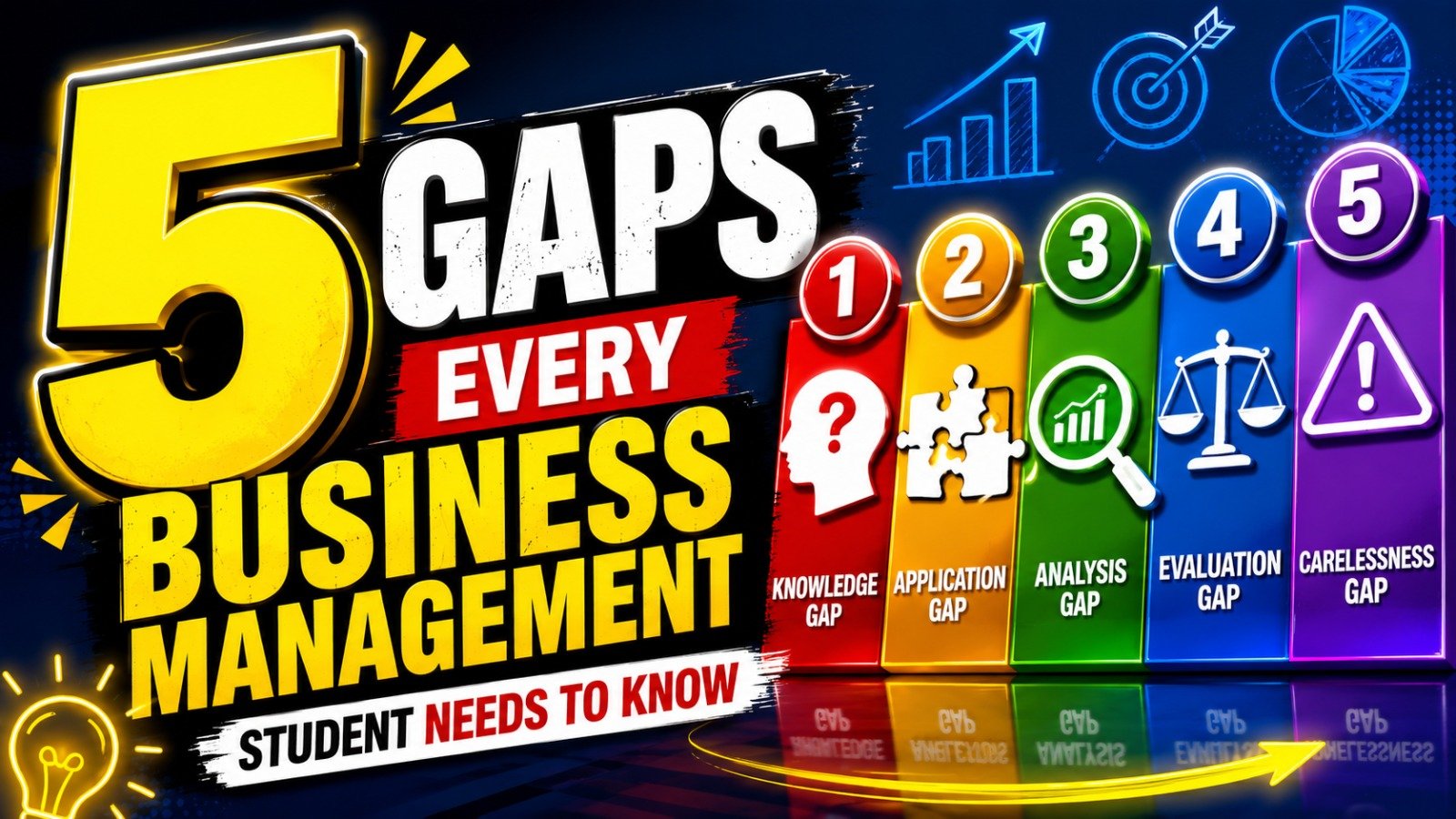
Over time, I have found that many student mistakes can be grouped into five major gaps: the Knowledge Gap, Application Gap, Analysis Gap, Evaluation Gap, and Carelessness Gap. Understanding these gaps is the first step towards closing them.
1. The Knowledge Gap – “I don’t know it.”
This is the most obvious gap. The student simply does not have the required subject knowledge.
For example, a question asks:
“Explain one advantage of using market segmentation.”
A student who does not understand market segmentation may struggle to identify a valid advantage, let alone explain it.
In Business Management, knowledge includes definitions, concepts, theories, formulas, methods, and business terminology. If students do not know what market share, contribution, delegation, liquidity, or economies of scale means, higher-order thinking becomes extremely difficult.
How to close it: Build strong foundations. Learn key terms, understand concepts rather than memorising isolated definitions, and regularly practise retrieval through short quizzes and flash questions.
But knowledge is only the beginning.
2. The application gap – “I know it, but I can’t connect it to the business.”
This is one of the most common problems in Business Management examinations.
Imagine a case study about a small bakery that is experiencing rising costs. The question asks students to explain how economies of scale could benefit the business.
A student might correctly write:
“Economies of scale occur when the average cost of production decreases as output increases.”
That is knowledge.
But the answer needs to go further. The student should connect the concept to the bakery:
“If the bakery increases production, it may be able to purchase flour and packaging in bulk at lower prices, reducing its average cost per unit.”
Now the concept is applied to the specific business.
Application means answering the question: “What does this concept mean for this particular business?”
How to close it: When reading a case study, underline the important business facts—size, objectives, financial position, employees, market, competitors and problems. Then deliberately connect your Business Management concept to those facts.
3. The analysis gap – “I can explain it, but I can’t show what happens next.”
Analysis is where many students lose marks.
Consider a business that introduces performance-related pay to motivate employees.
A basic answer might say:
“Performance-related pay may motivate employees because they can earn more money.”
That is reasonable, but the analysis is limited.
A stronger answer develops a chain of reasoning:
Performance-related pay → employees have greater incentive to improve performance → productivity may increase → output per employee may rise → unit costs may fall → profitability may improve.
Analysis is about showing cause and effect.
A useful question to ask is:
“So what happens next?”
After every point, push your thinking one step further. Then another.
4. The Evaluation Gap – “I can see both sides, but I can’t make a judgement.”
Evaluation is not simply writing “however” or “it depends.”
It requires a reasoned judgement based on the situation.
For example, a business may be considering entering an international market. One advantage is increased sales revenue. However, expansion may also involve high marketing costs, unfamiliar regulations and strong local competitors.
A weak evaluation says:
“Therefore, international expansion could be good or bad depending on the situation.”
A stronger evaluation asks:
What matters most for this business?
If the business has strong finances, excess production capacity and a well-established brand, expansion may be attractive. However, if cash flow is weak and management lacks international experience, the risks may outweigh the benefits.
Evaluation therefore requires prioritisation, context and judgement.
5. The carelessness gap – “I actually knew this!”
Perhaps the most frustrating gap is carelessness.
A student knows the formula but substitutes the wrong figure. They calculate correctly but forget the unit. They read “increase” as “decrease.” They answer a 10-mark question in four lines. They misread the command term or forget to use information from the case study.
These are not knowledge problems. They are execution problems.
The solution is simple but powerful: slow down at the right moments.
Read the command term carefully. Check calculations. Use the case study. Look at the number of marks available. Leave a few minutes to review your answers.
Closing thoughts: Close the gap, raise the grade
Strong Intro to Business Management performance is not about knowing more and more content. It is about moving successfully through the chain:
Knowledge → Application → Analysis → Evaluation
—and making sure carelessness does not destroy the marks you have earned.
The good news is that every gap can be improved.
If you have a Knowledge Gap, learn.
If you have an Application Gap, connect.
If you have an Analysis Gap, develop the chain of reasoning.
If you have an Evaluation Gap, make a judgement.
And if you have a Carelessness Gap, slow down and check.
The next time you lose marks in Business Management, don’t simply ask, “What was the correct answer?”
Ask the more important question:
“Which gap caused me to lose the mark?”
Once you identify the gap, you can begin to close it—and that is where real improvement begins.