Table of Contents
Meaning of capital expenditure
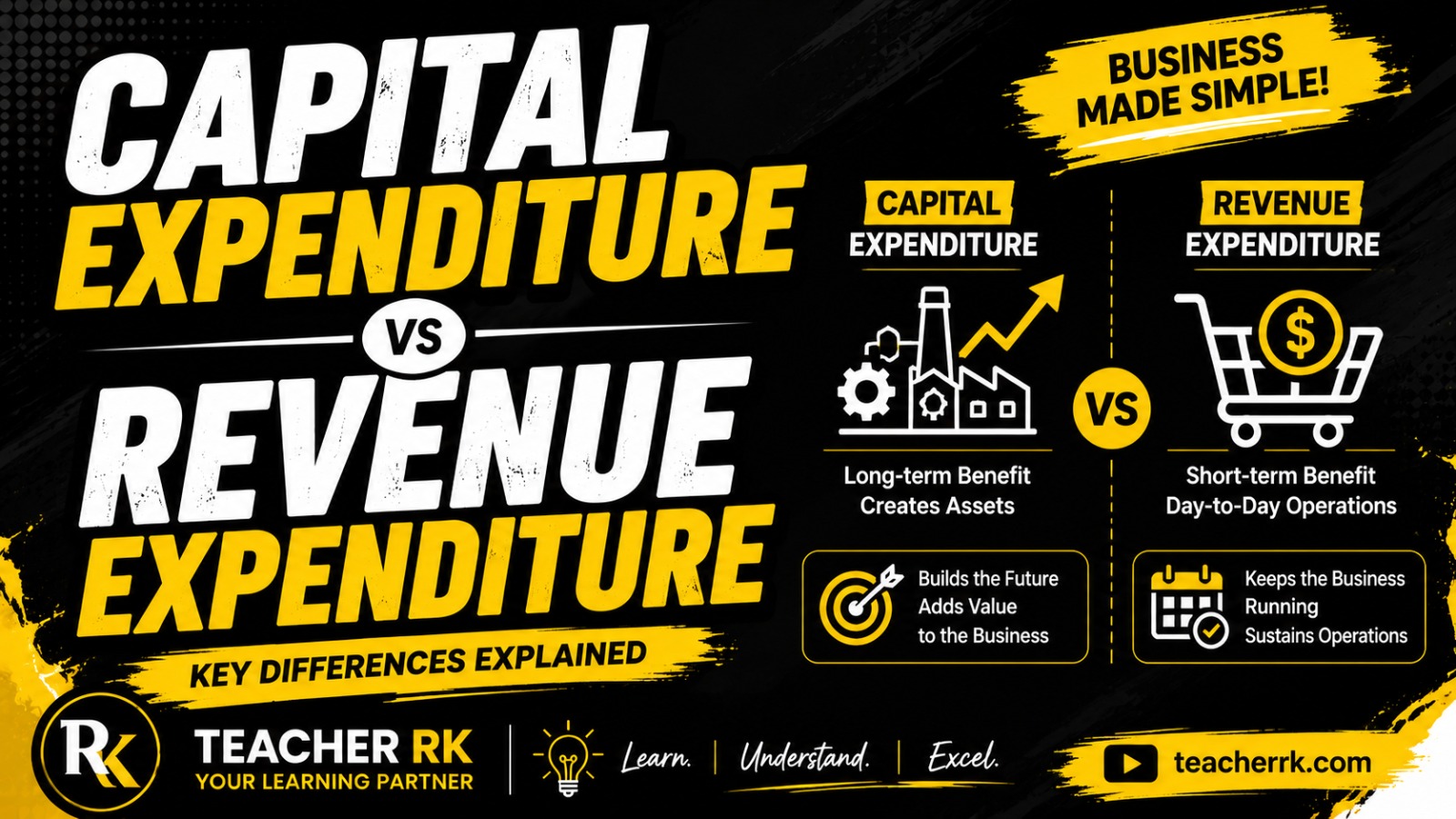
Capital expenditure refers to money spent on acquiring, improving, or upgrading long-term assets that will benefit the business for more than one accounting period. These expenditures help increase the earning capacity or operational efficiency of the business.
Features and examples of capital expenditure
| Features of capital expenditure | Examples of capital expenditure |
| 1. Involves the purchase or improvement of long-term assets· 2. Provides benefits over several years· 3. Usually involves large amounts of money· 4. Increases the value or capacity of the business· 5. Recorded as an asset in the financial statements | 1. Purchasing machinery and equipment· 2. Buying land or buildings· 3. Constructing a new factory· 4. Purchasing delivery vehicles· 5. Major upgrades to existing facilities |
Meaning Revenue expenditure
Revenue expenditure refers to spending on the day-to-day running of a Business Management. These expenditures are incurred regularly and their benefits are usually consumed within the current accounting period.
Features and examples of revenue expenditure
| Features of revenue expenditure | Examples of revenue expenditure |
| 1. Incurred for daily business operations· 2. Provides short-term benefits· 3. Occurs frequently and repeatedly· 4. Helps maintain existing assets and operations· 5. Recorded as an expense in the income statement | 1. Employee salaries and wages· 2. Rent and utility bills· 3. Advertising expenses· 4. Repairs and maintenance· 5. Office supplies and stationery |
Differences between capital and revenue expenditures
| Basis of Comparison | Capital Expenditure | Revenue Expenditure |
| Purpose | Incurred to acquire, improve, or upgrade long-term assets | Incurred for the day-to-day operations of the business. |
| Benefit Period | Provides benefits over several accounting periods. | Benefits are usually consumed within the current accounting period |
| Amount | Usually involves a large amount of money | Usually involves smaller and recurring amounts. |
| Accounting Treatment | Recorded as an asset in the statement of financial position (balance sheet). | Recorded as an expense in the income statement. |
| Examples | Purchase of machinery, buildings, and vehicles | Salaries, rent, advertising, and utility bills. |
Overall, capital expenditure helps a business grow and improve its long-term earning capacity, whereas revenue expenditure helps maintain the day-to-day operations of the business. Both are necessary for the successful functioning of an organization.
Quick Recap
1. Finance is the management of money and financial resources required to start, operate, and grow a business.
2. Businesses need Sources of finance to purchase assets, pay employees, buy inventory, fund marketing, support research, and expand operations.
3. Capital expenditure is money spent on acquiring, improving, or upgrading long-term assets that provide benefits over several accounting periods.
4. Examples of capital expenditure include purchasing machinery, buildings, land, vehicles, and major improvements to existing assets.
5. Revenue expenditure is spending on the day-to-day running of a business, with benefits usually consumed within the current accounting period.
6. Examples of revenue expenditure include salaries, rent, utilities, advertising, repairs, and office supplies.
7. Capital expenditure is recorded as an asset in the Statement of Financial Position (Balance Sheet), Depreciation whereas revenue expenditure is recorded as an expense in the Income Statement.
8. Both capital and revenue expenditure are essential—capital expenditure supports long-term growth, while revenue expenditure ensures the smooth day-to-day operation of the business.