
Table of Contents
Introduction
The Ansoff Matrix is one of the most useful strategic planning tools for understanding how a business can grow. Developed by Igor Ansoff, the matrix helps businesses evaluate growth opportunities by considering two key dimensions: products and markets.
At first glance, the model looks simple. But it becomes much more powerful when students and managers use it to analyse real business decisions, assess risk, and justify strategic choices.
In this guide, we will explore the four Ansoff Matrix strategies—market penetration, market development, product development, and diversification—with practical examples and an explanation of the risks associated with each strategy.
What Is the Ansoff Matrix?
The Ansoff Matrix is a strategic planning framework that businesses use to identify potential growth strategies.
It is based on two questions:
- Is the business selling existing or new products?
- Is the business targeting existing or new markets?
Understanding the Ansoff Matrix
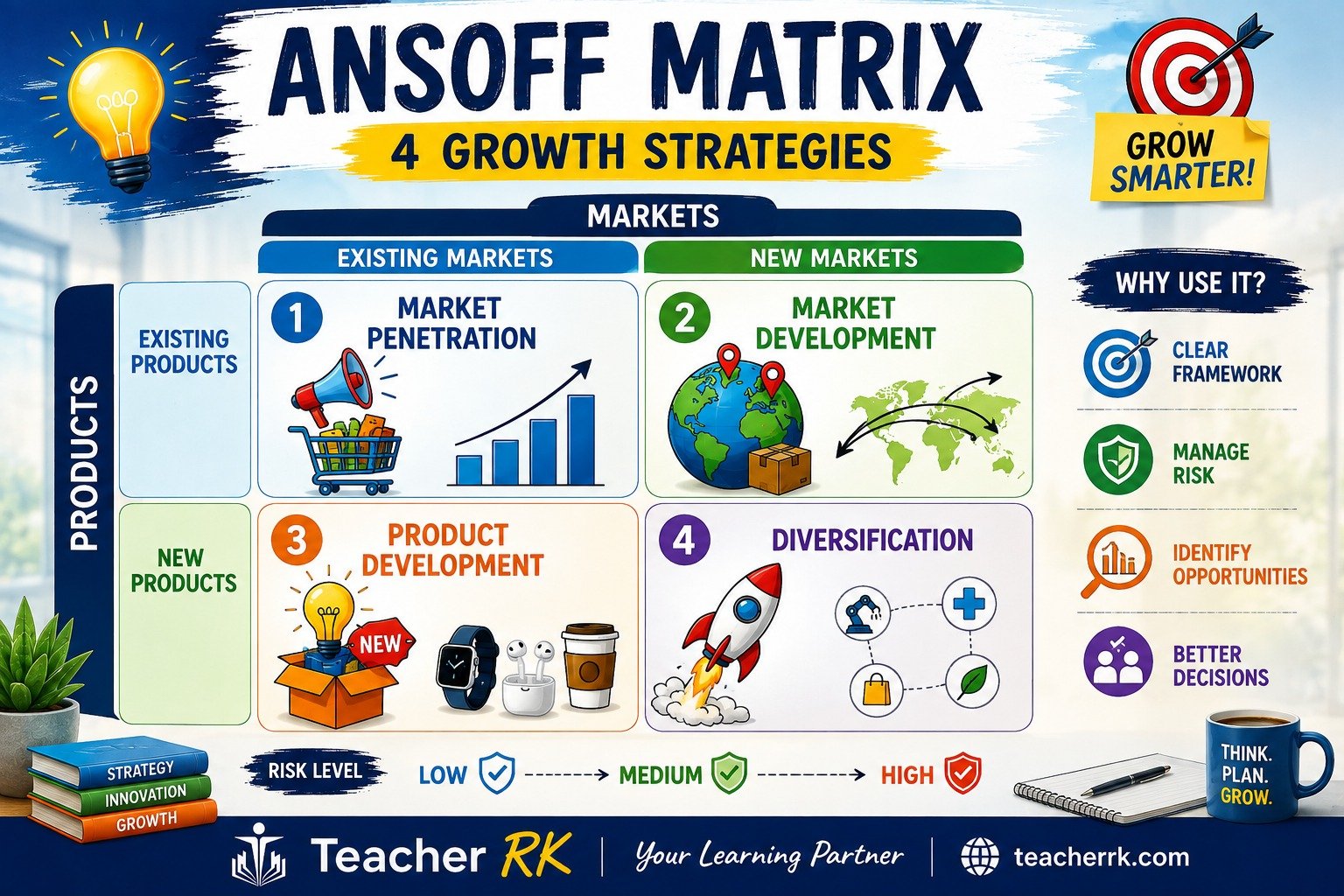
The four strategies represent different levels of opportunity and risk.
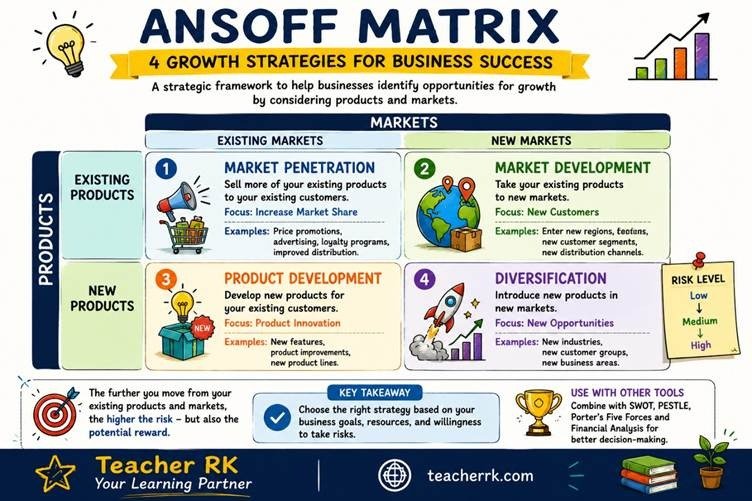
- Market Penetration – The concept of increasing sales of existing products into an existing market
- Market Development – Focuses on selling existing products into new markets
- Product Development – Focuses on introducing new products to an existing market
- Diversification – The concept of entering a new market with altogether new products
Generally, the further a business moves away from its existing products and markets, the greater the level of risk.
Let’s examine each strategy.
1. Market Penetration
Existing Products + Existing Markets
Market penetration involves selling more of an existing product to an existing market.
The business already understands its customers and operates in a familiar market. Its objective is to increase market share.
How can a business achieve market penetration?
A business might:
ü Reduce prices
ü Offer promotional discounts
ü Increase advertising
ü Improve customer loyalty programmes
ü Encourage customers to purchase more frequently
ü Improve distribution
ü Attract customers from competitors
2. Market Development
Existing Products + New Markets
Market development involves taking an existing product into a new market.
The new market could be:
- A different geographical location
- A different customer segment
- A new demographic group
- A new distribution channel
Example: Netflix
Netflix originally focused heavily on DVD rental before expanding its streaming service into international markets.
The company used an existing core service but introduced it to new geographical markets, adapting its content and marketing to local audiences.
Why choose market development?
A business may choose market development when:
- The existing market has limited growth potential.
- The business has strong brand recognition.
- The existing product can satisfy needs in another market.
- There are attractive opportunities in new geographical regions.
Risk
The business may not fully understand the new market.
Consumer preferences, culture, regulations, income levels and competition can all be different.
Therefore, market development generally carries more risk than market penetration.
3. Product Development
New Products + Existing Markets
Product development involves creating or introducing new products for existing customers.
The business already understands its target market but must develop products that customers will want to buy.
Example: Apple
Apple provides a useful example of product development through the introduction of new products and product categories to its existing customer base.
For example, customers who already purchased Apple products could potentially be offered products such as the Apple Watch or AirPods.
The company can use its existing brand reputation, customer relationships and distribution network to support the launch.
Why choose product development?
Businesses may use product development when:
- Customer needs are changing.
- Existing products are reaching maturity.
- The business has strong research and development capabilities.
- Customers trust the brand.
- The business wants to increase revenue per customer.
Risk
Developing a new product can be expensive.
The business may invest heavily in research, development, production and marketing without knowing whether customers will accept the new product.
4. Diversification
New Products + New Markets
Diversification involves entering a new market with a new product.
It is generally considered the highest-risk strategy in the Ansoff Matrix because the business is moving into unfamiliar territory on both dimensions.
Example: Amazon
Amazon provides an interesting example of diversification.
The company began primarily as an online bookseller but expanded into areas such as cloud computing through Amazon Web Services (AWS).
AWS operates in a substantially different business area from Amazon’s original online book retailing activities.
Why choose diversification?
A business might diversify to:
- Reduce dependence on its existing market.
- Spread risk across different businesses.
- Take advantage of emerging opportunities.
- Use existing resources or capabilities in new ways.
- Create new sources of revenue.
Risk
Diversification can be challenging because the business may have limited knowledge of the new product and the new market.
It may require significant:
- Investment
- Research
- New skills
- Marketing
- Technology
- Human resources
Therefore, diversification should normally involve careful research and strategic planning.
Ansoff Matrix: Risk and Reward
The four strategies can be viewed as a progression:
Market Penetration → Market Development → Product Development → Diversification
As the business moves further away from its existing products and markets, strategic uncertainty and risk generally increase.
Advantages and Disadvantages of Ansoff matrix
| Advantages of the Ansoff Matrix | Limitations of the Ansoff Matrix |
| 1. Provides a clear framework: It helps managers organise different growth possibilities into four categories.· 2. Encourages strategic thinking: Managers are encouraged to consider both products and markets rather than focusing only on sales growth.· 3. Highlights risk: The matrix helps businesses recognise that entering unfamiliar markets or developing new products can increase uncertainty.· 4. Supports decision-making: It can help managers compare different growth options before committing significant resources. | 1. It is relatively simple: Real business decisions are more complicated than simply categorising products and markets as “new” or “existing.” 2. Risk is not always predictable: The model suggests that diversification is more risky, but a well-researched diversification strategy could sometimes be less risky than entering a highly competitive existing market. 3. It does not consider competitors directly: The matrix does not provide detailed analysis of competitive forces. |
Final thoughts
The Ansoff Matrix is more than a four-box diagram. It provides businesses with a structured way to think about growth, opportunity and risk. A business does not necessarily need to choose the most ambitious strategy. Sometimes, increasing sales in an existing market is the most sensible approach. At other times, changing customer preferences, technological developments or market opportunities may encourage a business to develop new products or enter new markets.