Table of Contents
Introduction
While the Profit and Loss Account shows the financial performance of a business over a period of time, the Statement of Financial Position, commonly known as the Balance Sheet, provides a snapshot of the financial position of a business at a specific point in time. It shows what the business owns, what it owes, and the value belonging to the owners.
Meaning of balance sheet
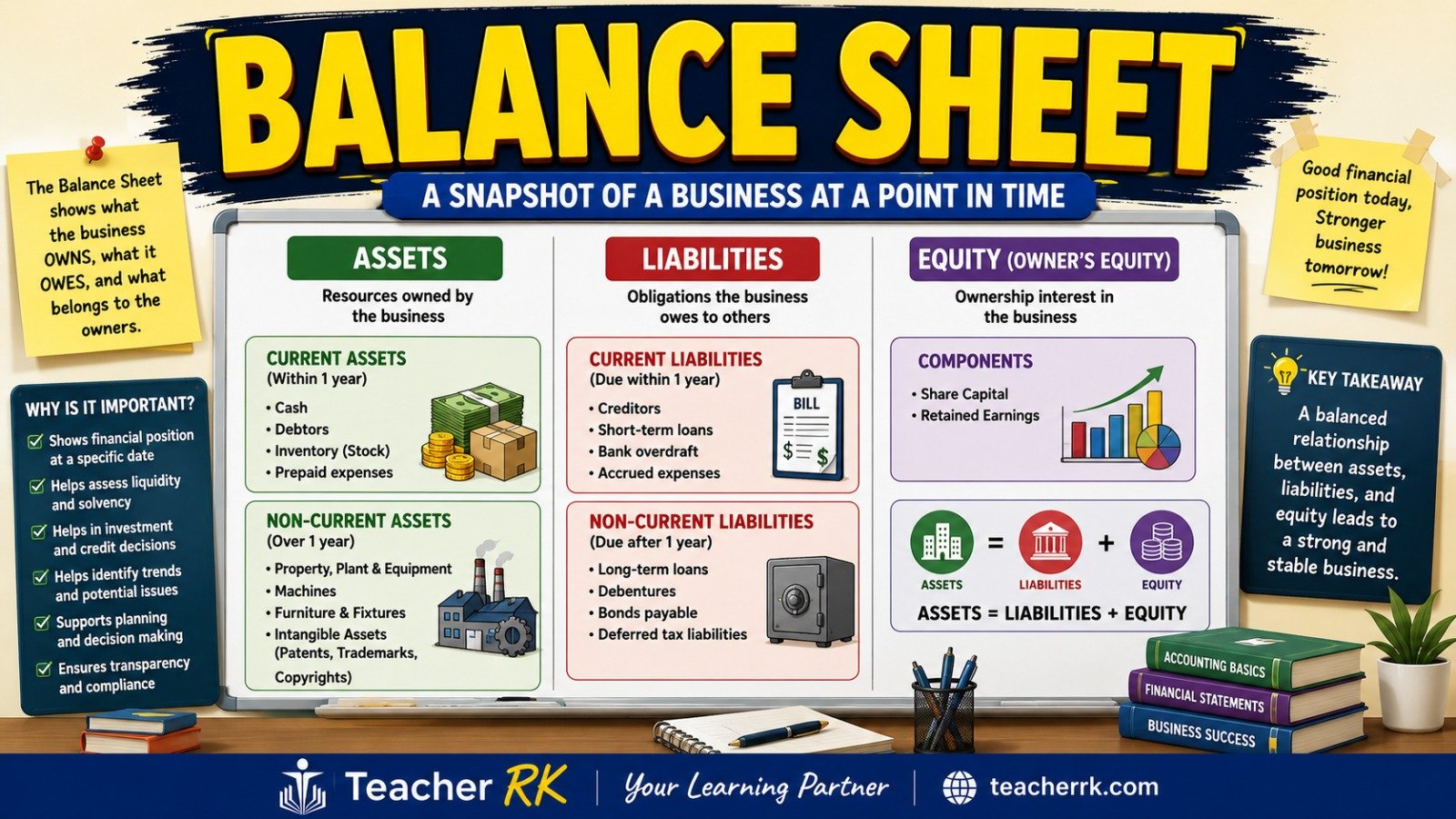
A balance sheet is a financial statement that provides a snapshot of a company’s financial position at a specific point in time. It details the company’s assets, liabilities, and shareholders’ equity, showing how these elements balance out according to the fundamental accounting equation: Assets = Liabilities + Shareholders’ Equity
Components of a balance sheet
The balance sheet has three components: Assets, Liabilities, and Equity.
- Assets: Resources owned by the company that are expected to bring future economic benefits. Assets are usually classified into, current assets and non-current assets
- Current Assets: Cash and other assets that are expected to be converted into cash or used up within one year. Examples include cash, debtors, and inventory( stock)
- Non-Current Assets (Fixed Assets): Long-term investments and resources that are not expected to be converted into cash within a year. Examples include property, plant, equipment, machines, and intangible assets such as copyrights, trademarks, patents, etc.
- Liabilities: Obligations the company owes to external parties that are expected to be settled in the future. Liabilities are classified into:
- Current Liabilities: Debts and obligations that are due within one year. Examples include creditors, short-term loans, and bank overdraft
- Non-Current Liabilities: Long-term debts and obligations that are due after one year. Examples include long-term loans, debentures, bonds payable, and deferred tax liabilities.
- Shareholders’ Equity (Owner’s Equity): It represents the ownership interest of the shareholders. Components of shareholders’ equity include share capital and retained earnings.
Importance of the balance sheet
- Financial position: It provides a clear and comprehensive Finance view of the company’s financial position at a specific point in time, showing what the company owns and owes.
- Liquidity assessment: It helps assess the company’s ability to meet its short-term and long-term obligations. Investors and creditors use this information to evaluate the company’s solvency and liquidity.
- Investment decisions: Investors analyze the balance sheet to make informed decisions about buying, holding, or selling shares based on the company’s financial stability and growth potential.
- Creditworthiness: Lenders and creditors review the balance sheet to determine the creditworthiness of the company and to decide whether to extend credit or loans.
- Trend analysis: By comparing balance sheets over multiple periods, stakeholders can identify trends, growth patterns, and potential financial issues.
- Internal management: Management uses the balance sheet to make strategic decisions, plan for future investments, and manage resources effectively.
- Regulatory compliance: It is a mandatory document for financial reporting and compliance with regulatory requirements, ensuring transparency and accountability.
The Statement of Financial Position (Balance Sheet) provides a summary of a business’s assets, liabilities, and owner’s equity at a specific point in time. It is an essential financial statement that helps stakeholders evaluate the financial strength, stability, and liquidity of the business.
Format of the balance sheet
(Insert name of the company here)
Statement of financial position as at ( insert dater and month)
| ($) | |
| Non-current assets: | |
| Plant and machinery | 30,000 |
| Accumulated depreciation | (2000) |
| Total non-current assets | 28,000 |
| Current assets: | |
| Cash | 10,000 |
| Debtors | 8000 |
| Stock | 12,000 |
| Total current assets | 30, 000 |
| Total assets ( Non-current assets + current assets) | 58,000 |
| Current liabilities: | |
| Bank overdraft | 8000 |
| Trade creditors | 2000 |
| Short-term loans | 2000 |
| Total current liabilities | 12,000 |
| Non-current liabilities: | |
| Long-term loans | 10,000 |
| Total liabilities (Non-current liabilities + Current liabilities) | 22,000 |
| Net assets (Total assets – Total liabilities) | 36,000 |
| Equity: | |
| Share capital | 22,000 |
| Retained earnings | 14,000 |
| Total equity | 36,000 |
Intangible assets
Intangible assets are non-physical assets owned by a business that provide long-term economic benefits. Unlike buildings, machinery, or inventory, intangible assets cannot be seen or touched, but they can be extremely valuable to a business.
Goodwill
Goodwill represents the value of a business’s reputation, customer loyalty, brand recognition, and strong relationships with stakeholders. It often arises when a business is purchased for more than the value of its identifiable assets.
Example: A popular restaurant with a loyal customer base may have significant goodwill.
Patents
A patent is a legal right granted to an inventor that gives exclusive rights to make, use, or sell an invention for a specified period. Patents protect innovative products, processes, or technologies from being copied by competitors. Example: A pharmaceutical company may patent a new medicine.
Copyrights
A copyright is a legal right that protects original creative works such as books, music, films, software, and artistic creations. It prevents others from copying, reproducing, or distributing the work without permission. Example: A software company holds copyright protection over its computer programs.
Trademarks
A trademark is a legally protected symbol, logo, name, phrase, or design that identifies and distinguishes a company’s products or services from those of competitors. Example: The Nike “Swoosh” logo and the Apple logo are trademarks.
Conclusion
Thus, intangible assets may not have a physical form, but they often play a crucial role in creating competitive advantage and long-term value for a Business Management. Goodwill, patents, copyrights, and trademarks help businesses protect their reputation, innovations, and brand identity.