
Table of Contents
Introduction
Great businesses don’t succeed because they have no problems. They succeed because they understand their problems before others do.”
Imagine you want to open a café. You have excellent coffee recipes, a prime location, and enthusiastic friends willing to help. But there is a new café opening next door, and you have limited funds. Should you still proceed?
This is exactly where SWOT Analysis becomes one of the most powerful business tools.
SWOT Analysis helps entrepreneurs, managers, and students evaluate a business by identifying what it does well, where it needs improvement, and what opportunities and threats exist in the external environment.
What is SWOT analysis?
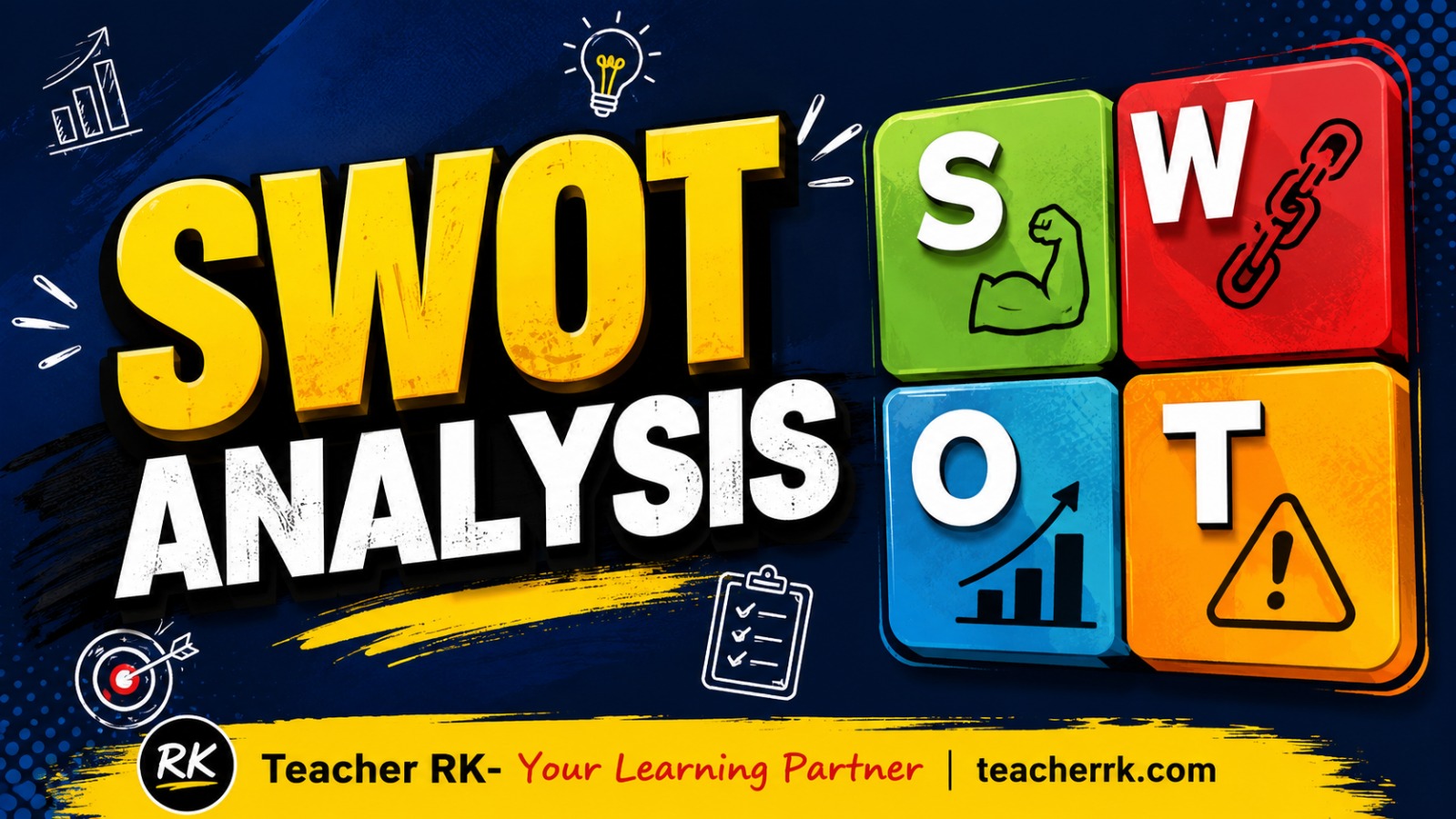
SWOT Analysis is a strategic planning tool used to evaluate a business or project by examining four important factors:
- S – Strengths
- W – Weaknesses
- O – Opportunities
- T – Threats
It helps organizations understand their current position before making important business decisions.
Simple Definition
SWOT Analysis is a framework used to identify the internal strengths and weaknesses of a business and the external opportunities and threats that may affect its success.
Why is SWOT analysis important?
Businesses operate in constantly changing environments. Customer preferences change, competitors launch new products, technology evolves, and governments introduce new regulations.
A SWOT analysis helps businesses:
- Understand their competitive position
- Make informed strategic decisions
- Improve long-term planning
- Reduce risks
- Identify growth opportunities
- Allocate resources effectively
Without understanding both internal and external factors, businesses may make poor strategic decisions.
The four components of SWOT analysis
| 1. Strengths (Internal Positive Factors)Strengths are the advantages that give a business a competitive edge.They answer the question: “What do we do better than our competitors?”Examples include:Strong brand reputationLoyal customersSkilled employeesInnovative productsAdvanced technologyEfficient productionStrong financial positionExcellent customer service | 2. Weaknesses (Internal Negative Factors)Weaknesses are areas where the business performs poorly or lacks resources.They answer: “Where do we need improvement?”Examples include:High production costsLimited financial resourcesWeak online presencePoor customer serviceOutdated technologyHigh employee turnoverLimited product range |
| 3. Opportunities (External Positive Factors)Opportunities are external conditions that can help the business grow.These are usually outside the firm’s control but can be exploited successfully.Examples include:Growing market demandNew technologyExpansion into international marketsGovernment incentivesChanging consumer preferencesDeclining competitorsStrategic partnerships | 4. Threats (External Negative Factors)Threats are external challenges that may reduce business performance.Examples include:New competitorsEconomic recessionRising inflationGovernment regulationsSupply chain disruptionsChanging customer tastesTechnological disruptionNatural disasters |
Advantages and limitations of SWOT analysis
| Advantages of SWOT analysis | Limitations of SWOT analysis |
1. Easy to Understand: Anyone can learn and use SWOT analysis without advanced business knowledge.· 2. Supports Strategic Planning: Helps businesses choose the best strategies.· 3. Encourages Better Decision-Making: Managers can evaluate multiple factors before investing.· 4. Identifies Competitive Advantage: Shows what makes a business unique.· 5. Helps Reduce Risks: Recognizing threats early allows businesses to prepare contingency plans. | 1. Subjective: Different people may identify different strengths and weaknesses.· 2. No Prioritization: SWOT lists factors but does not rank their importance.· 3. Static Snapshot: Business environments change rapidly, making SWOT outdated unless updated regularly.· 4. No Solutions: It identifies issues but does not explain how to solve them. |
Key takeaways
· SWOT stands for Strengths, Weaknesses, Opportunities, and Threats.
· Strengths and weaknesses are internal factors.
· Opportunities and threats are external factors.
· SWOT helps businesses evaluate their current position.
· It supports better strategic planning and decision-making.
· The analysis should lead to practical strategies rather than simply listing factors.
· Regular updates ensure the SWOT analysis remains relevant in changing business environments.
Final thoughts
Every successful business—from startups to multinational corporations—needs to understand where it stands before deciding where to go.
SWOT Analysis provides a clear and structured way to assess internal capabilities and external challenges. Whether you’re launching a new business, entering a new market, or planning future growth, SWOT helps you make smarter, more informed decisions.
Remember:
“Knowing your strengths builds confidence. Understanding your weaknesses builds improvement. Recognizing opportunities creates growth. Preparing for threats ensures survival.







One Comment