Table of Contents
Why do some businesses thrive while others struggle, even when they have great products?
The answer often lies outside the business. A company may have an excellent product, talented employees, and sufficient finance, but factors such as government regulations, technological advancements, changing customer preferences, or environmental concerns can significantly influence its success.
To understand these external influences, businesses use a powerful strategic planning tool called STEEPLE Analysis.
What is STEEPLE Analysis?
STEEPLE Analysis is a strategic framework used to identify and evaluate the external factors that can affect a business. These factors are generally beyond the control of the business but can create both opportunities and threats.
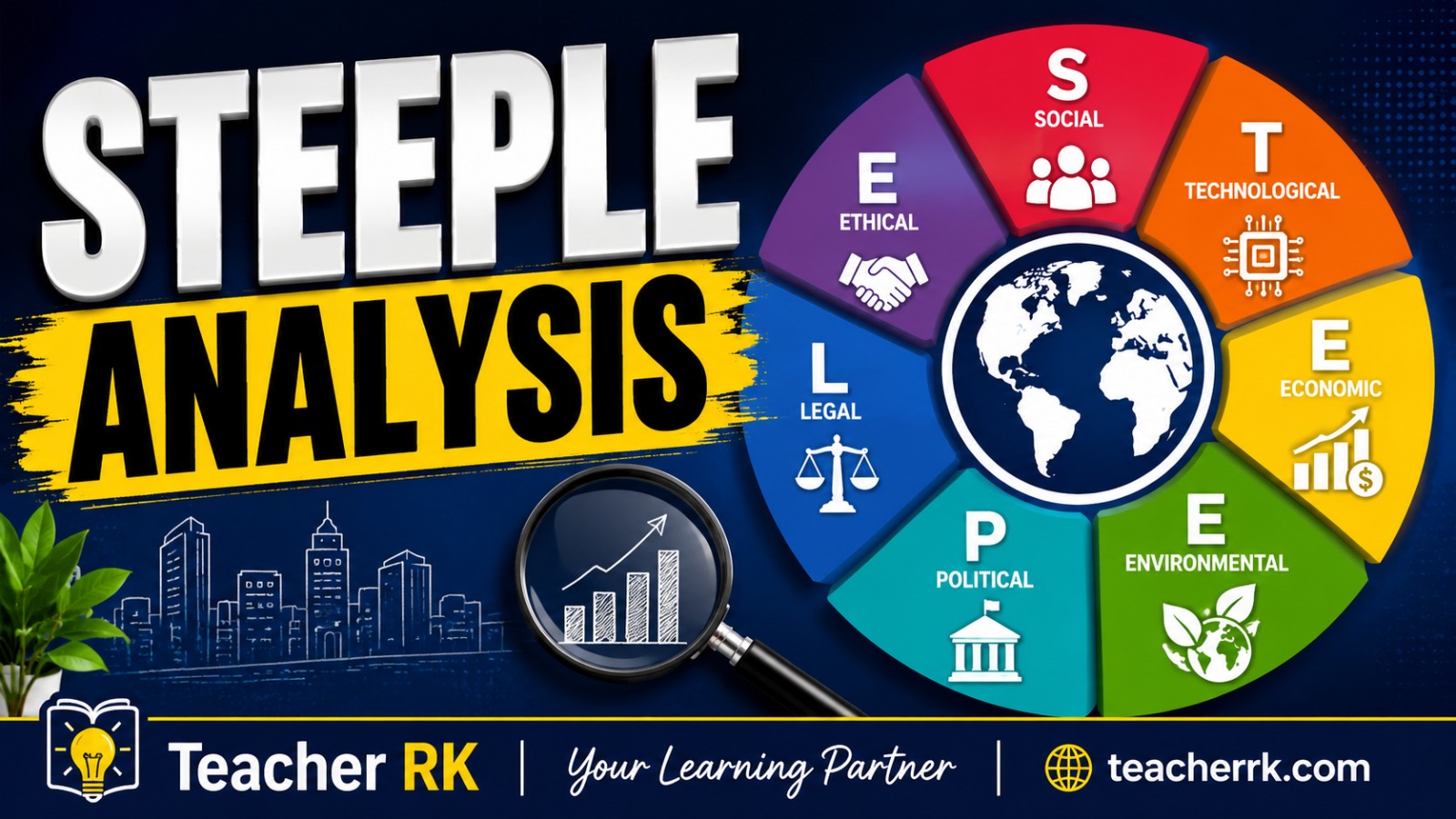
The acronym STEEPLE stands for:
S – Social
T – Technological
E – Economic
E – Environmental
P – Political
L – Legal
E – Ethical
By analysing these factors, businesses can make informed decisions, reduce risks, and identify future opportunities.
In simple words: STEEPLE Analysis helps businesses understand what is happening in the world around them before making important decisions.
Elements of STEEPLE Analysis
1. Social Factors
Social factors refer to changes in people’s lifestyles, values, culture, education, demographics, and consumer behaviour. Businesses need to understand society because customer preferences change over time.
Examples
· Growing health consciousness increases demand for organic foods.
· An ageing population creates opportunities for healthcare services.
· Rising use of social media changes marketing strategies.
· More people working remotely increases demand for home office furniture.
2. Technological Factors
Technology is transforming every industry. Businesses that fail to adopt new technology often lose their competitive advantage.
Examples
- Artificial Intelligence improves customer service through chatbots.
- Automation reduces manufacturing costs.
- Cloud computing enables remote work.
- Online payment systems improve customer convenience.
3. Economic Factors
Economic conditions influence both consumers and businesses. Factors such as inflation, unemployment, interest rates, exchange rates, and economic growth affect purchasing power and business profitability.
Examples
· High inflation increases production costs.
· Rising interest rates make borrowing more expensive.
· Economic recessions reduce consumer spending.
· Low unemployment increases wage costs for businesses.
4. Environmental Factors
Environmental factors focus on the natural environment and sustainability. Modern businesses are expected to reduce pollution, conserve resources, and adopt environmentally friendly practices.
Examples
- Climate change affects agricultural production.
- Customers prefer recyclable packaging.
- Governments encourage renewable energy.
- Water shortages affect manufacturing industries.
5. Political Factors
Political decisions directly affect businesses through government policies and public spending.
Examples
- New taxation policies
- Import and export tariffs
- Trade agreements
- Government subsidies
- Political stability
6. Legal Factors
Legal factors include laws and regulations that businesses must follow.
Failure to comply can result in fines, lawsuits, or reputational damage.
Examples
- Employment laws
- Consumer protection laws
- Health and safety regulations
- Data privacy laws
- Intellectual property protection
7. Ethical Factors
Ethical factors relate to doing what is morally right, even when it is not legally required. Modern consumers increasingly support businesses that act responsibly.
Examples
- Fair wages for employees
- Ethical sourcing of raw materials
- Honest advertising
- Animal welfare
- Corporate social responsibility initiatives
Why is STEEPLE Analysis important?
STEEPLE Analysis helps businesses understand the external environment before making strategic decisions. Its key benefits include:
- Identifies opportunities: Businesses can recognise emerging trends and enter new markets before competitors.
- Recognises potential threats: It helps organisations prepare for risks such as new laws, technological disruption, or economic downturns.
- Improves strategic planning: Managers can make better long-term decisions based on future trends rather than assumptions.
- Supports innovation: Understanding technological and social changes encourages businesses to develop innovative products and services.
- Enhances risk management: Businesses can prepare contingency plans for external changes beyond their control.
- Strengthens competitive advantage: Companies that continuously monitor the external environment often adapt faster than competitors.
Though, STEEPLE Analysis is a valuable strategic tool, but it has some limitations. It cannot accurately predict future events, and external factors can change rapidly, making the analysis outdated. Interpreting large amounts of information can also be challenging, and different analysts may reach different conclusions based on the same data. Therefore, STEEPLE Analysis is most effective when used alongside other strategic tools, such as SWOT Analysis, to provide a more comprehensive understanding of the business environment.
Conclusion
In today’s rapidly changing business environment, organisations cannot afford to focus only on what happens inside the business. External forces such as technological innovation, economic conditions, government policies, environmental concerns, and changing social values continuously shape business success.
STEEPLE analysis provides a systematic way to understand these external influences, helping businesses identify opportunities, minimise risks, and make informed strategic decisions. While it does not predict the future, it equips managers with valuable insights to adapt proactively and remain competitive.
Whether you are a student learning business management or a manager planning your next strategic move, mastering STEEPLE Analysis is an essential step toward making smarter business decisions.
| Key Takeaway: A successful business doesn’t just react to change—it anticipates it. STEEPLE Analysis helps organisations stay prepared for the future by understanding the world around them. |