
Table of Contents
Introduction
For a business to operate successfully, it must estimate how much it expects to sell in the future. Accurate sales forecasts help managers make informed decisions about production, staffing, inventory, marketing, and financial planning. Since business resources are often limited, forecasting helps organizations prepare for future opportunities and challenges.
Meaning of sales forecasting
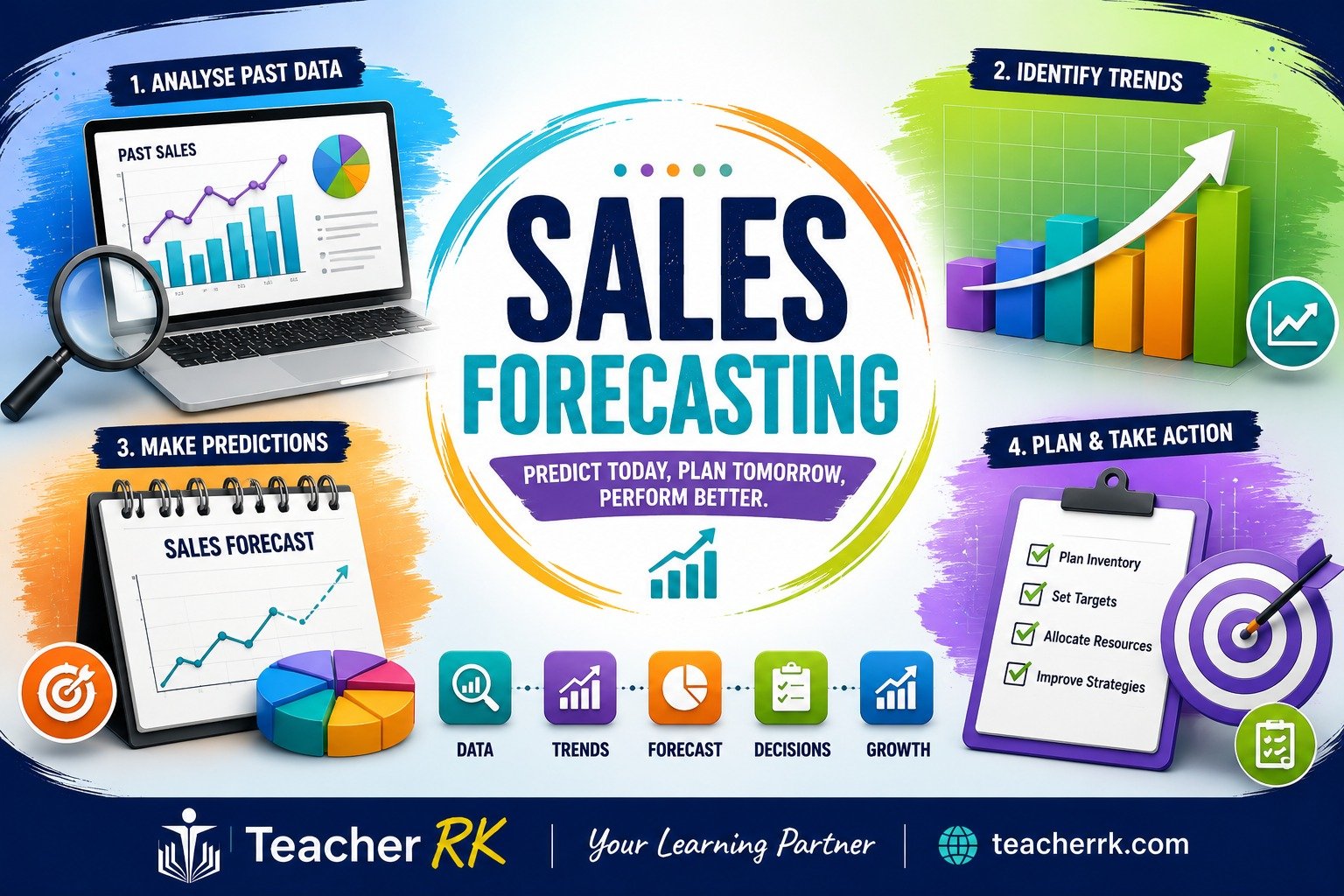
Sales forecasting meaning is the process of estimating the future sales revenue or sales volume of a business over a specific period of time. It involves analyzing historical data, market trends, customer demand, and other relevant factors to predict future sales performance.
Sales forecasts help businesses plan their activities and make better strategic and operational decisions.
Sales forecasting methods
Historical sales data
This method uses past sales performance to predict future sales. Businesses analyze previous sales trends and assume that similar patterns may continue in the future.
Example: A retailer uses the past three years’ sales data to estimate sales for the upcoming year.
Market research
Businesses collect information from customers through surveys, interviews, focus groups, and questionnaires to estimate future demand.
Example: A company surveys potential customers before launching a new product.
Sales Force Estimates
Sales forecasts are based on predictions provided by sales representatives who interact directly with customers and understand market conditions.
Example: Sales staff estimate future demand based on customer inquiries and orders.
Time Series Analysis
Time series analysis is a sales forecasting method that uses historical sales data collected over a period of time to identify patterns, trends, seasonal variations, and cycles. Businesses use these patterns to predict future sales.
Extrapolation method
Extrapolation is a forecasting method that uses past trends and extends them into the future. It assumes that existing sales patterns will continue unless significant changes occur in the business environment.
Benefits and limitations of sales forecasting
| Benefits of sales forecasting | Limitation of sales forecasting |
| 1. Supports business planning and decision-making 2. Helps manage inventory and production levels 3. Assists in budgeting and financial planning 4. Improves resource allocation and staffing decisions 5. Reduces uncertainty and business risk | 1. Forecasts are based on assumptions and estimates· 2. Unexpected market changes can reduce accuracy· 3. Forecasting errors may lead to poor business decisions |
Sales forecasting helps businesses estimate future demand and sales performance. By using methods such as historical data, market research, sales force estimates, expert opinions, and test marketing, businesses can plan more effectively and allocate resources efficiently. However, forecasts are not always accurate, and managers should use them alongside professional judgment and market intelligence.
Quick recap
1. Sales forecasting is the process of estimating future sales revenue or sales volume over a specific period of time.
2. Businesses use sales forecasts to support decision-making related to production, staffing, inventory, marketing, and finance.
3. Historical sales data forecasting uses past sales performance to predict future sales trends.
4. Market research forecasting relies on customer surveys, interviews, focus groups, and questionnaires to estimate future demand.
5. Sales force estimates use predictions provided by sales representatives based on their interactions with customers and knowledge of market conditions.
6. Time series analysis examines historical sales data to identify trends, seasonal variations, and recurring patterns that can be used to forecast future sales.
7. Extrapolation involves extending past sales trends into the future, assuming that existing patterns will continue.
8. Sales forecasting helps businesses improve planning, manage inventory, allocate resources efficiently, and prepare budgets.
9. Accurate sales forecasts can reduce uncertainty and help businesses respond more effectively to future opportunities and challenges.
10. Sales forecasts are based on assumptions and estimates, so unexpected changes in market conditions may reduce their accuracy.