Table of Contents
Introduction
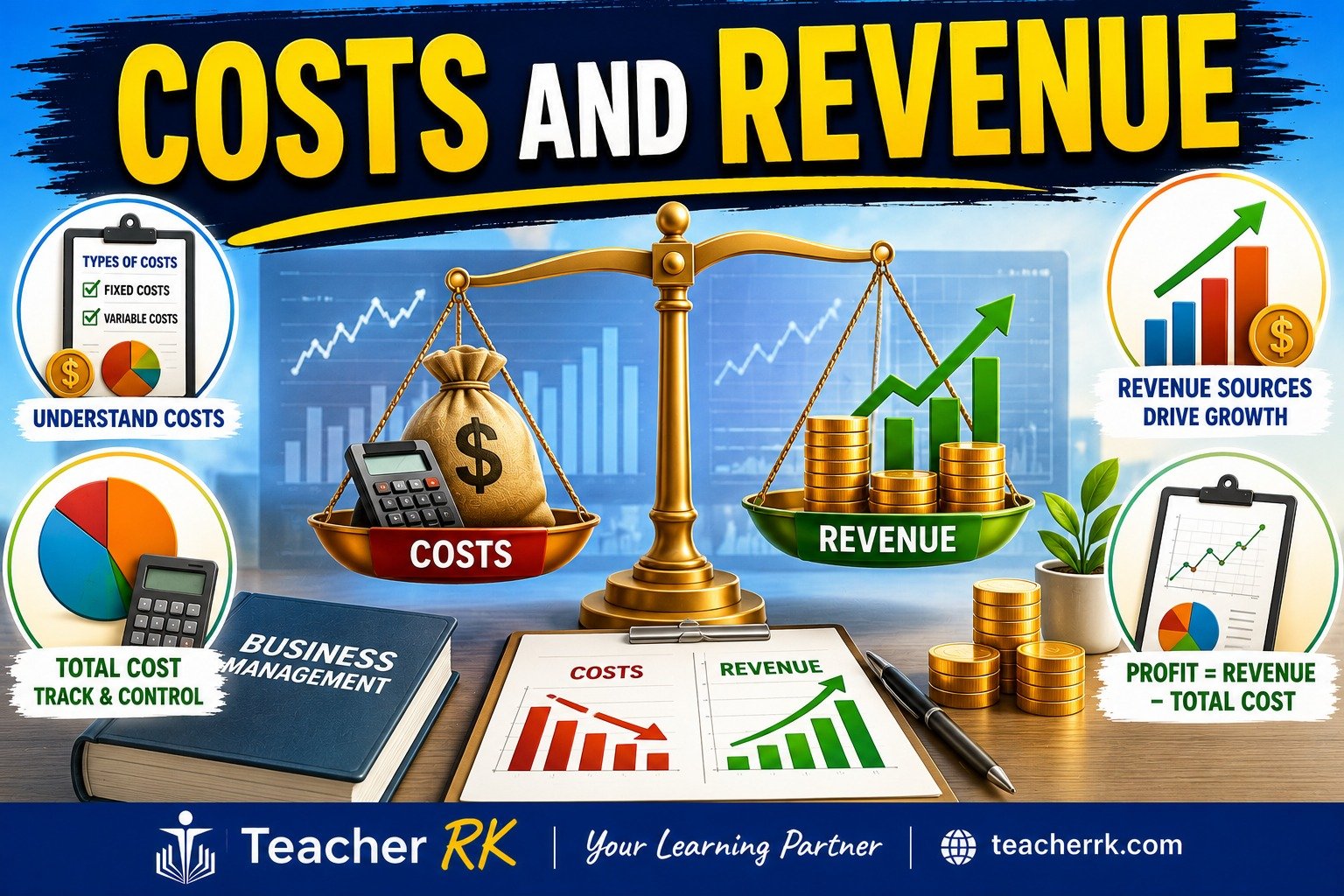
In business, costs refer to the expenses incurred in producing goods or providing services. Businesses must spend money on resources such as raw materials, labor, rent, utilities, and equipment to operate effectively. Understanding costs is essential because they directly affect profitability, pricing decisions, and overall business performance.
Business costs can be classified into different categories, with the most common being fixed costs and variable costs. Effective cost management helps Business Management control expenses, improve efficiency, and achieve their financial objectives.
Meaning of fixed cost
Fixed costs are business expenses that remain unchanged regardless of the level of production or sales. These costs must be paid even if the business produces no goods or services during a given period.
Features of Fixed Costs
· Remain constant within a given period
· Do not vary with the level of output or sales
· Must be paid even when production is zero
· Easier to predict and budget for
· Usually relate to the general operation of the business rather than production levels
Thus, fixed costs are incurred regardless of business activity and provide stability in financial planning. However, businesses must cover these costs even during periods of low sales or production.
Meaning of variable cost
Variable costs are business expenses that change in direct proportion to the level of production or sales. As output increases, variable costs increase; as output decreases, variable costs decrease.
Features of Variable Costs
· Vary according to the level of output or sales
· Increase when production increases
· Decrease when production decreases
· Usually related directly to the production process
· Become zero when no goods or services are produced (in most cases)
Thus, Variable costs fluctuate with business activity and are directly linked to production or sales levels. Managing variable costs effectively can help businesses improve profitability and operational efficiency.
Examples of fixed cost and variable cost
| Examples of fixed costs | Examples of variable costs |
| 1. Rent of premises· 2. Insurance premiums· 3. Property taxes· 4. Salaries of permanent administrative staff· 5. Loan repayments· 6. Depreciation of fixed assets | 1. Raw materials· 2. Packaging materials· 3. Direct labour (paid per unit produced)· 4. Sales commissions· 5. Delivery and shipping costs· 6. Utility costs directly linked to production |
Meaning of direct costs and indirect costs
Meaning of direct costs
Direct costs are expenses that can be directly and easily traced to the production of a specific product or the delivery of a particular service. These costs are incurred specifically for producing goods or services.
Examples: Raw materials, production workers’ wages, packaging materials, and components used in manufacturing.
Meaning of indirect costs
Indirect costs are expenses that cannot be directly linked to a specific product or service. These costs support the overall operation of the business and are shared across different products, services, or departments.
Examples: Rent, insurance, utility bills, office salaries, and administrative expenses.
| Fixed or Variable → How does the cost behave when output changes? Direct or Indirect → Can the cost be traced to a specific product? |
| Note: In most cases, indirect costs are fixed costs, while direct costs are variable costs. However, these classifications are not the same. A cost may be classified as direct or indirect based on whether it can be traced to a specific product or service, and as fixed or variable based on how it changes with the level of output. Therefore, depending on the nature of the business activity, both direct and indirect costs can be either fixed or variable. |
Key Takeaway
Think of Fixed vs Variable and Direct vs Indirect as two separate classifications.
For every cost, ask:
Question 1
Does the cost change when output changes?
- Yes → Variable
- No → Fixed
Question 2
Can the cost be traced to a specific product or service?
- Yes → Direct
- No → Indirect
Once students realize that every cost can have one answer to each question, the distinction becomes much easier to understand.
Total cost and average cost
| Total Cost | Average Cost |
| Total cost is the overall cost incurred by a business in producing goods or services. It includes both fixed costs and variable costs. Formula: Total Cost = Fixed Costs + Variable Costs Example: If a business has: Fixed costs = $10,000 Variable costs = $15,000Total Cost = $10,000 + $15,000 = $25,000 | Average cost is the cost of producing one unit of output. It is calculated by dividing the total cost by the number of units produced. Formula: Average Cost = Total Cost ÷ Number of Units Produced Example: If a business incurs: Total cost = $25,000Output = 5,000 units Average Cost = $25,000 ÷ 5,000 = $5 per unit |
Revenue and revenue streams
Revenue is one of the most important indicators of a business’s financial performance. It represents the income generated from selling goods or providing services to customers. Businesses rely on revenue to cover costs, earn Profit and Loss , and support future growth. Understanding how revenue is generated helps businesses make informed decisions about pricing, marketing, and expansion strategies.
Revenue
Revenue is the total amount of money a business earns from its normal operating activities, primarily through the sale of goods and services, before any expenses are deducted.
Examples
· A clothing store earns revenue from selling apparel.
· A restaurant earns revenue from selling food and beverages.
· A consulting firm earns revenue by providing professional advice and services.
Formula: Revenue = Selling Price × Quantity Sold
Revenue Streams
A revenue stream refers to a specific source of income generated by a business through its various activities. Businesses may earn revenue from multiple streams, such as sales of products, sponsorships, royalties, subscriptions, commissions, and merchandise sales.
Examples of revenue streams
· Sale of products
· Service fees
· Subscription fees
· Advertising revenue
· Commission income
· Licensing fees
· Rental income
· Franchise fees
Example
A fitness center may have several revenue streams:
- Membership fees
- Personal training services
- Sale of fitness merchandise
- Online fitness classes
By having multiple revenue streams, the business becomes less dependent on a single source of income.
Key Difference
Revenue refers to the total income earned by a business, while revenue streams refer to the different sources from which that income is generated.
Thus, revenue is essential for the survival and growth of a business. By developing multiple revenue streams, businesses can diversify their income sources, improve financial stability, and reduce the risks associated with relying on a single source of revenue.
Quick Recap
1. Business costs are the expenses incurred in producing goods or providing services and directly affect profitability and pricing decisions.
2. Costs can be classified as fixed or variable based on how they behave when the level of output changes.
3. Fixed costs remain the same regardless of the level of production or sales and must be paid even if output is zero.
4. Common examples of fixed costs include rent, insurance, property taxes, salaries of administrative staff, loan repayments, and depreciation.
5. Variable costs change in direct proportion to the level of production or sales—they increase as output increases and decrease as output decreases.
6. Common examples of variable costs include raw materials, packaging, direct labour, sales commissions, delivery costs, and production-related utilities.
7. Costs can also be classified as direct or indirect based on whether they can be traced to a specific product or service.
8. Direct costs are directly attributable to producing a product or service, such as raw materials, production wages, and packaging materials.
9. Indirect costs support the overall operation of the business and cannot be traced to a single product, such as rent, insurance, office salaries, and administrative expenses.
10. Fixed ≠ Indirect and Variable ≠ Direct. These are different classifications—a cost can be fixed or variable and direct or indirect, depending on its nature.
11. Revenue is the total income a business earns from its normal operating activities through the sale of goods or services, before any expenses are deducted.
12. Revenue can be calculated using the formula: Revenue = Selling Price × Quantity Sold.
13. Revenue is essential because it helps businesses cover costs, earn profits, and finance future growth.
14. A revenue stream is a specific source of income generated by a business through its various activities.
15. Common revenue streams include product sales, service fees, subscription fees, advertising revenue, commission income, licensing fees, rental income, and franchise fees.
16. Businesses with multiple revenue streams are less dependent on a single source of income, making them more financially stable and reducing business risk.
17. Understanding revenue and revenue streams helps businesses make better pricing, marketing, investment, and growth decisions.